- 0086-571-85302990
- [email protected]






Milk Thistle Extract: A Complete Guide to Benefits, Applications & Sourcing
2026-08-17
Introduction
Since ancient Greek times, milk thistle (Silybum marianum) has been revered as a natural liver protector. Modern scientific research has confirmed that its core active complex — Silymarin — demonstrates remarkable potential in hepatoprotection, antioxidant defense, and metabolic health. Today, Milk Thistle Extract is one of the most widely used botanical ingredients in the global dietary supplement and pharmaceutical industries, with a market value exceeding USD 280 million and growing steadily at a CAGR of 6.5%.
Part 1: What Is Milk Thistle Extract?
Botanical Profile
| Attribute | Detail |
|---|---|
| Botanical Name | Silybum marianum (L.) Gaertn. |
| Common Names | Milk thistle, blessed milk thistle, Marian thistle |
| Family | Asteraceae (Compositae) |
| Native Region | Mediterranean basin (Southern Europe, North Africa, Western Asia) |
| Major Cultivation | Hungary, Germany, China, Argentina, United States |
Extraction Part
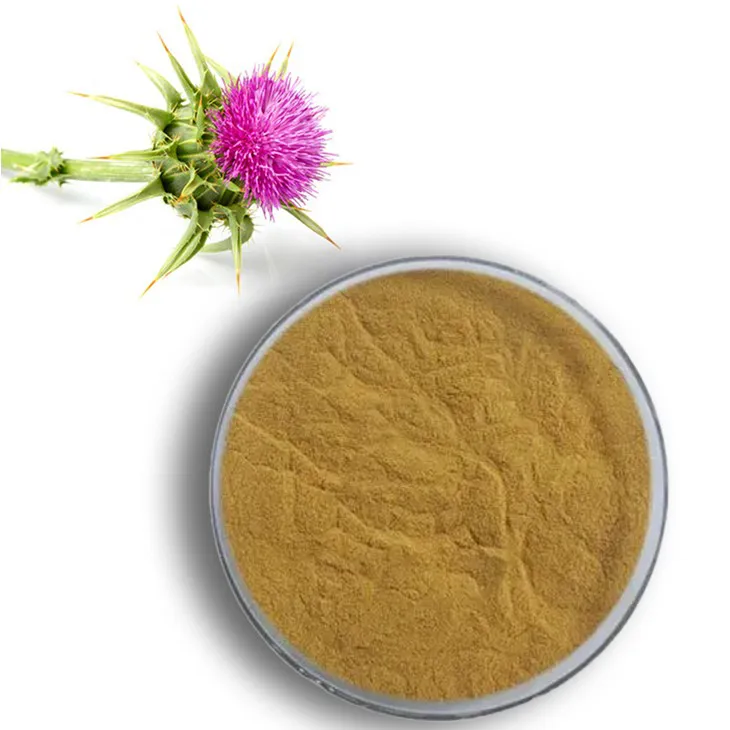
The seeds (fruits/achenes) of the milk thistle plant contain the highest concentration of silymarin, typically ranging from 1.5% to 3.0% by weight.
Active Compounds
Silymarin is not a single molecule but a complex of flavonolignans, including:
| Compound | Approximate % of Silymarin Complex |
|---|---|
| Silybin (Silibinin) | 50–70% |
| Isosilybin | 10–20% |
| Silydianin | 10–15% |
| Silychristin | 10–15% |
| Taxifolin | Trace amounts |
Silybin (Silibinin) is the most biologically active and well-studied component, responsible for the majority of milk thistle's hepatoprotective effects.
Standard Specifications We Offer
| Product Grade | Silymarin Content | Silybin Content | Application |
|---|---|---|---|
| Standard | 40% Silymarin (UV) | — | General supplements |
| Premium | 80% Silymarin (UV) | ≥40% Silybin | Pharmaceutical grade |
| Ultra | 98% Silymarin (HPLC) | ≥60% Silybin | R&D, clinical use |
Custom specifications are available upon request.
Certificate of Analysis (Typical)
| Parameter | Specification | Typical Result |
|---|---|---|
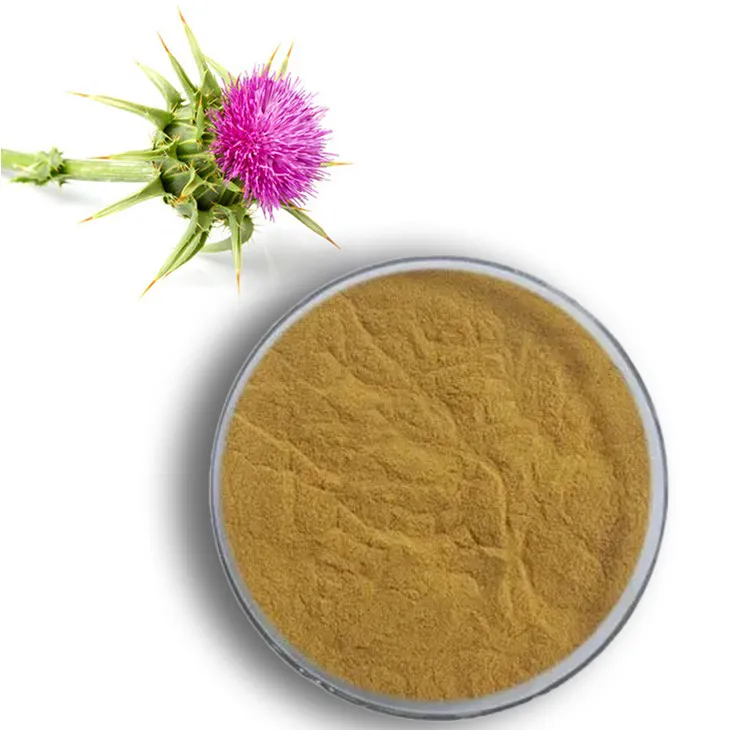
| Appearance | Brownish-yellow to dark brown fine powder | Conforms |
| Odor | Characteristic | Conforms |
| Silymarin (UV) | ≥80% | 82.3% |
| Silybin (HPLC) | ≥40% | 43.7% |
| Loss on Drying | ≤5.0% | 3.2% |
| Ash | ≤5.0% | 3.8% |
| Heavy Metals (Pb, As, Cd, Hg) | Compliant | Pass |
| Pesticide Residues | Compliant | Pass |
| Microbiological (TBC, Yeast/Mold, E. coli, Salmonella) | Compliant | Pass |
Part 2: Core Benefits & Mechanisms of Action
1. Hepatoprotection & Liver Regeneration
Silymarin's most celebrated and evidence-backed benefit is its multi-target hepatoprotective activity:
Membrane stabilization: Silybin binds to hepatocyte membranes, preventing toxin penetration by modifying membrane structure and reducing permeability (Flora et al., 1998).
Antioxidant defense: Scavenges reactive oxygen species (ROS), increases intracellular glutathione (GSH) levels by up to 35%, and superoxide dismutase (SOD) activity.
Protein synthesis stimulation: Activates RNA polymerase I in hepatocytes, promoting liver cell regeneration after injury (Morazzoni & Bombardelli, 1995).
Anti-fibrotic activity: Inhibits hepatic stellate cell activation and reduces collagen deposition, slowing progression of liver fibrosis.
Clinical Evidence: A meta-analysis of randomized controlled trials (RCTs) published in Phytotherapy Research (2017) concluded that silymarin significantly improved liver enzyme profiles (ALT, AST) in patients with alcoholic liver disease and NAFLD. [PubMed: 28332213]
2. Antioxidant & Anti-Aging Effects
Silymarin is a potent free-radical scavenger, with antioxidant capacity approximately 10 times that of vitamin E:
Directly neutralizes hydroxyl radicals (•OH) and superoxide anions (O₂•⁻).
Upregulates endogenous antioxidant enzymes (SOD, CAT, GPx).
Protects mitochondrial function by reducing lipid peroxidation (MDA reduction).
3. Anti-Inflammatory Activity
Silymarin modulates key inflammatory pathways:
NF-κB inhibition: Suppresses nuclear factor kappa B activation, reducing pro-inflammatory cytokine production (TNF-α, IL-6, IL-1β).
COX-2 suppression: Downregulates cyclooxygenase-2 expression, comparable in mechanism to NSAIDs but without gastrointestinal side effects.
MAPK pathway modulation: Regulates p38 and JNK signaling cascades involved in chronic inflammation.
Reference: A 2020 study in Antioxidants demonstrated that silybin reduced LPS-induced inflammatory responses in macrophages by 60–75% via NF-κB and MAPK pathway inhibition. [PubMed: 32545710]
4. Anticancer Potential (Emerging Research)
Preclinical studies suggest silymarin exhibits chemopreventive properties:
Induces apoptosis in prostate, breast, colon, and liver cancer cell lines.
Inhibits angiogenesis via VEGF suppression.
Synergistic enhancement of conventional chemotherapy agents.
Note: These findings are primarily from in vitro and animal models. Human clinical trials are ongoing.
5. Metabolic & Cardiovascular Support
Emerging evidence links silymarin to metabolic health benefits:
Blood glucose regulation: A 2016 RCT (n=256, Type 2 diabetic patients) showed silymarin supplementation (600 mg/day) reduced fasting blood glucose by 19% and HbA1c by 1.03% over 4 months. [PubMed: 26990668]
Lipid modulation: Reduces LDL cholesterol and triglycerides in metabolic syndrome patients.
Cardioprotection: Reduces oxidative stress markers and improves endothelial function.
Part 3: Wide-Ranging Applications
Pharmaceutical & Dietary Supplements
Capsules & tablets: Standardized 80% silymarin for liver support supplements (daily dosage: 140–600 mg).
Intravenous formulations: Silibinin IV (Legalon® SIL) for acute Amanita phalloides (death cap mushroom) poisoning — an FDA-approved orphan drug indication.
Combination products: Formulated with turmeric Curcumin, Artichoke Extract, or dandelion root for comprehensive liver health protocols.
Functional Foods & Beverages
Energy & wellness drinks: Added as a functional botanical for detoxification claims.
Meal replacement shakes: Integrated for antioxidant and liver support positioning.
Gummy supplements: Growing segment targeting younger consumers with palatable delivery formats.
Cosmetics & Personal Care
Anti-aging serums: Silymarin's antioxidant potency positions it as a natural alternative to synthetic antioxidants.
Sun care products: UV-protective and anti-inflammatory properties for post-sun repair formulations.
Acne treatments: Anti-inflammatory and sebum-regulating effects support clear skin formulations.
Market Note: The global silymarin cosmetics market is projected to reach USD 45 million by 2028.
Animal Nutrition
Livestock feed additive: Improves liver function in high-producing dairy cows, reducing metabolic disorders during transition periods.
Poultry health: Mitigates aflatoxin-induced liver damage in poultry feed.
Pet supplements: Growing demand for canine and feline liver support supplements containing silymarin.
Research & Biotechnology
Cell culture antioxidant additive
Standard reference material for analytical method development
Preclinical toxicology studies
Part 4: How to Choose a High-Quality Milk Thistle Extract
Key Quality Indicators
| Factor | Why It Matters |
|---|---|
| Purity & Standardization | Look for HPLC-verified silymarin and silybin content. UV screening alone can be misleading. |
| Extraction Technology | Ethanol extraction followed by purification ensures consistent silymarin profiles. CO₂ supercritical extraction is emerging for premium grades. |
| Third-Party Testing | Independent COA verification from ISO 17025 accredited labs ensures label claims are accurate. |
| Solvent Residues | Ethanol extraction should leave <5000 ppm residual solvent (ICH Q3C compliant). |
| Microbiological Safety | Must pass total bacterial count, yeast/mold, E. coli, and Salmonella tests. |
| Heavy Metals & Pesticides | Compliant with USP <232>/<233>, EP 5.2.8, or Chinese Pharmacopoeia standards. |
| Organic Certification | USDA Organic, EU Organic, or equivalent certifications for clean-label products. |
| Supplier Credentials | GMP, ISO 22000, HACCP, FAMI-QS certifications indicate manufacturing quality systems. |
Red Flags to Avoid
Adulteration with synthetic silybin or unrelated flavonoids Inconsistent batch-to-batch potency Missing or non-verifiable COAs Suppliers unable to provide traceability from seed to extract
Part 5: About Us
As a specialized botanical extract manufacturer with years of experience in research, production, and global supply, we offer Milk Thistle Extract with the following advantages:
Vertical Integration: From cultivated Silybum marianum seeds to finished extract — full traceability at every stage.
Advanced Extraction: Optimized ethanol extraction with chromatographic purification, ensuring consistent silymarin and silybin content batch after batch.
Quality Assurance: Every batch is tested in-house (HPLC, UV, GC-MS) and verified by independent third-party laboratories. Full COA documentation provided.
Certifications: GMP, ISO 22000, HACCP, Kosher, Halal, and Organic certifications available.
Custom Solutions: Tailored specifications, particle sizes, and formulations (including water-soluble silymarin-phytosome complexes) to meet your exact product requirements.
Stable Supply: Strategic raw material reserves and multiple cultivation partnerships ensure year-round availability and competitive pricing.
Technical Support: Our R&D team provides formulation guidance, stability testing data, and regulatory documentation to accelerate your product development.
Conclusion & Get a Quote
Milk thistle extract remains one of the most scientifically validated and commercially successful botanical ingredients worldwide. From liver health supplements to functional foods, cosmetics, and animal nutrition, the demand for high-purity, consistently standardized silymarin continues to grow.
Ready to source premium Milk Thistle Extract?
Contact us today for the latest pricing, free samples, and technical specifications.
Our expert team is ready to provide:
Competitive quotations within 24 hours
Free sample for quality evaluation (up to 10g)
Custom specification development
Full regulatory and technical documentation
Don't compromise on quality — let us be your trusted botanical extract partner.
- ▶ Hesperidin
- ▶ Citrus Bioflavonoids
- ▶ Plant Extract
- ▶ lycopene
- ▶ Diosmin
- ▶ Grape seed extract
- ▶ Sea buckthorn Juice Powder
- ▶ Fruit Juice Powder
- ▶ Hops Extract
- ▶ Artichoke Extract
- ▶ Mushroom extract
- ▶ Astaxanthin
- ▶ Green Tea Extract
- ▶ Curcumin
- ▶ Horse Chestnut Extract
- ▶ Other Product
- ▶ Boswellia Serrata Extract
- ▶ Resveratrol
- ▶ Marigold Extract
- ▶ Grape Leaf Extract
- ▶ New Product
- ▶ Aminolevulinic acid
- ▶ Cranberry Extract
- ▶ Red Yeast Rice
- ▶ Red Wine Extract
- ▶ blog
-
Camu Camu Extract
2026-08-17
-
Kupilu Extract
2026-08-17
-
Curcumin
2026-08-17
-
Clove Powder
2026-08-17
-
Chaga Mushroom Extract
2026-08-17
-
Dan Shen Root Extract/Salvia Root Extract
2026-08-17
-
Lavender Extract
2026-08-17
-
Beta Carotene
2026-08-17
-
Europen Bilberry Extract
2026-08-17
-
Agaricus Blazei Extract
2026-08-17
