- 0086-571-85302990
- [email protected]






Vitex agnus-castus Extract
2025-12-10
Vitex agnus-castus Extract
1. Introduction
Vitex agnus-castus extract, also known as chaste tree berry extract, comes from the dried fruits of Vitex agnus-castus L. It has a long history in European and Mediterranean herbal practice for women’s reproductive health, especially for relieving premenstrual symptoms, supporting cycle regularity, and easing cyclic breast discomfort. Modern pharmacological and clinical studies suggest that standardized Vitex extracts can modulate prolactin and other pituitary hormones, and may help balance symptoms related to the menstrual cycle.
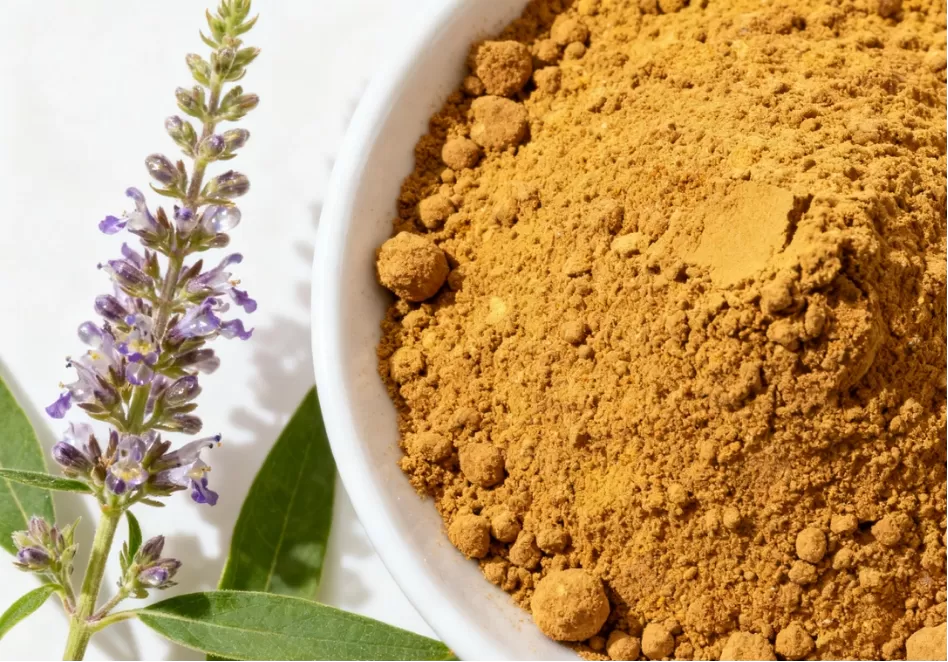
2. What Is Vitex agnus-castus Extract?
• Botanical Source
Vitex agnus-castus Extract is produced from Vitex agnus-castus L., a shrub of the Lamiaceae/Verbenaceae family widely distributed around the Mediterranean region and Western Asia. Its fruits (“chaste berries”) are the medically used part in both traditional and modern applications.
• Extracted Part
According to the product specification, the fruit is used as the raw material for extraction.
• Typical Test Methods
a) Identification: TLC
b) Heavy metals & specific elements: Atomic Absorption
c) Solvent residues: Gas Chromatography
d) Physical tests (mesh size, appearance, odor, taste): Organoleptic & sieve analysis
e) Microbiology: Standard plate count and pathogen detection methods
Additional testing (HPLC profiling, polyphenol content, iridoid marker analysis) can be applied according to customer requirements and pharmacopeial standards.
3. Key Health Benefits & Mechanisms of Action
1) Relief of Premenstrual Syndrome (PMS) Symptoms
Vitex agnus-castus is best known for its use in PMS. Standardized fruit extracts have been evaluated in multiple randomized, placebo-controlled clinical trials.
l In a large RCT of 170 women with PMS, a dry extract of Vitex agnus-castus fruit (Ze 440) significantly reduced core PMS symptoms (irritability, mood swings, breast fullness, headache, bloating) compared with placebo over three cycles, with a responder rate (≥50% symptom reduction) of 52% vs 24%.
l Subsequent RCTs and a meta-analysis of double-blind trials concluded that Vitex preparations are more effective than placebo in reducing overall PMS symptom scores, though effect sizes and formulations vary among studies.
Mechanism (PMS):
Vitex fruit extracts appear to act partly via dopaminergic activity at pituitary D₂ receptors, leading to reduced prolactin secretion, which may improve luteal function and alleviate PMS symptoms like breast tenderness, mood disturbance, and bloating.
2) Support for Cyclic Mastalgia (Cyclic Breast Pain)
Cyclic mastalgia (breast pain linked to the menstrual cycle) is another key indication for Vitex in gynecological practice.
l A systematic review and meta-analysis of clinical trials found that Vitex agnus-castus significantly improved cyclic mastalgia in many women, with higher response rates than placebo or some conventional comparators in several studies.
l Earlier clinical and observational work, summarized in review papers, reports reductions in pain intensity and frequency when standardized Vitex extracts are used for several cycles.
Mechanism (mastalgia):
Cyclic mastalgia is often associated with mild hyperprolactinaemia. Vitex’s prolactin-lowering effect and dopaminergic activity likely contribute to reduced breast tenderness and swelling.
3) Modulation of Prolactin & Pituitary Hormones (Hormonal Balance)
Preclinical and clinical evidence shows that Vitex agnus-castus exerts dopaminergic and endocrine-modulating effects relevant to female hormonal balance:
l In vitro studies using rat pituitary cells showed that Agnus castus extracts significantly inhibit prolactin release without suppressing LH or FSH, indicating a selective dopaminergic principle.
l A recent clinical review on Vitex and hyperprolactinaemia summarized case series and small trials where Vitex use was associated with reduced prolactin levels, improved luteal insufficiency, and normalization of menstrual disturbances in some patients.
4) Antioxidant & Phytochemical Support
Vitex fruits and leaves are rich in flavonoids, iridoids and phenolic compounds with antioxidant activity:
l A classic study demonstrated strong free-radical scavenging activity of water and ethanol extracts of Vitex agnus-castus leaves and fruits using the ABTS assay.
l More recent work on Vitex extracts (aqueous, ethanolic, methanolic) confirmed high total polyphenol and flavonoid contents and robust antioxidant capacity in multiple in-vitro models, supporting their role as natural antioxidant ingredients.
Antioxidant and phytoprotective properties complement the endocrine actions of Vitex and may contribute to long-term vascular, tissue and skin support when used in comprehensive women’s health or beauty-from-within formulas.
4. Applications of Vitex agnus-castus Extract
• Dietary Supplements & Nutraceuticals
Suitable for:
PMS and menstrual comfort formulas
Cyclic mastalgia / breast comfort blends
Women’s hormonal balance products (often combined with magnesium, vitamin B₆, evening primrose oil, etc.)
Menstrual cycle regularity and luteal phase support complexes
Common dosage forms:
Hard capsules, softgels, tablets
Powdered drink mixes, functional beverages
Tinctures or drops (where regulations permit)
• Gynecological & Clinical Nutrition Products
Vitex agnus-castus may be featured in:
a) Evidence-based gynecological nutraceuticals used under professional guidance
b) Complementary formulations for mild hyperprolactinaemia-related complaints and functional menstrual disorders, in line with regional regulations and EMA/monograph guidance.
• Cosmetics & Beauty-from-Within
Thanks to its:
a) Antioxidant phytochemical profile, and
b) Potential estrogen-receptor-related and skin-relevant bioactivities (from flavones and other constituents),
Vitex extract can be conceptually positioned in:
a) Oral “beauty & balance” supplements for women
b) Formulas that link hormonal comfort with skin wellness and anti-oxidative protection.
(Topical use should follow local cosmetic regulations and safety assessment.)
5. How to Choose a High-Quality Vitex agnus-castus Extract
• Extraction Quality
Prefer standardized extracts produced by controlled water or hydro-ethanolic extraction with validated processes.
• Safety & Purity Testing
High-quality suppliers must provide:
heavy metal analysis (As, Cd, Pb, Hg)
microbial tests (TAMC, yeast/mold, pathogens)
pesticide residue limits
solvent residue compliance
aflatoxin and PAH testing
• Certifications
Products should comply with:
GMP
ISO
COA with full test results
Allergen-free, GMO-free, additive-free status
• Stability & Quality Assurance
Ensure:
proper packaging
batch traceability
validated shelf life (typically 36 months)
6. About Us — Why Choose GreenSky Biological Technology?
With 21 years of experience in natural plant extracts, Hangzhou GreenSky Biological Technology is a trusted manufacturer supplying global food, supplement, and cosmetic brands. Established in 2004, we operate two professional factories -- a fermentation plant in Hangzhou and an extraction plant in Jiangxi — supported by a 3000+ sqm production base and a 1000 sqm fully equipped R&D center.
Our Advantages:
• Professional Expertise
Over two decades of focus on botanical extracts, delivering stable and high-grade ingredients such as Milk Thistle Extract and other functional actives.
• Reliable Quality
Strict HPLC testing, GMP-grade facilities, complete traceability, and multiple international certifications including HALAL, KOSHER, SGS, ISO, ECOCERT, BRCGS, and ISO22000.
• Flexible Customization
Support for various concentrations, purities, ratios, and particle sizes, including water-soluble forms and OEM/ODM services.
• Strong Supply Capacity
Annual output of 1000+ tons, ensuring stable and continuous supply from our Jiangxi production base and Hangzhou headquarters.
• Dedicated R&D Support
A complete laboratory system for quality testing, product development, and technical support.
7. Conclusion & Call-to-Action
Vitex agnus-castus Extract is a science-supported botanical ingredient for modern women’s health products. Clinical and preclinical research suggests benefits in PMS symptom relief, cyclic mastalgia, prolactin modulation and antioxidant support, making it an attractive choice for PMS, breast comfort, hormonal balance and beauty-from-within formulations.
Looking to upgrade your product line? Discover the quality of our premium Milk Thistle Extract.
Contact us now for a FREE SAMPLE and a competitive quotation. Our expert team will guide you toward the perfect ingredient solution.
References
Lutterodt H, Slavin M, Whent M, Turner E, Yu LL. (2011). Fatty acid composition, oxidative stability, antioxidant and antiproliferative properties of selected cold-pressed grape seed oils and flours. Food Chemistry, 128(2), 391–399. PMID: 25212146
Garavaglia J, Markoski MM, Oliveira A, Marcadenti A. (2016). Grape Seed Oil Compounds: Biological and Chemical Actions for Health. Nutrition and Metabolic Insights, 9, 59–64. PMID: 27559299
Gitea MA, et al. (2023). Evaluation of the Phytochemistry–Therapeutic Activity Relationship for Grape Seeds Oil. Life (Basel), 13(1), 178. PMID: 36676127
Irandoost P, Ebrahimi-Mameghani M, Pirouzpanah S. (2013). Does grape seed oil improve inflammation and insulin resistance in overweight or obese women? International Journal of Food Sciences and Nutrition, 64(6), 706–710. PMID: 23506314
Martin ME, Grao-Cruces E, Millan-Linares MC, Montserrat-de la Paz S. (2020). Grape (Vitis vinifera L.) Seed Oil: A Functional Food from the Winemaking Industry. Foods, 9(10), 1360. PMID: 32992712
Nayak BS, Ramdath DD, Marshall JR, et al. (2011). Wound-healing properties of the oils of Vitis vinifera and Vaccinium macrocarpon. Phytotherapy Research, 25(8), 1201–1208. PMID: 21305631
Harbeoui H, Dakhlaoui S, Wannes WA, et al. (2019). Does unsaponifiable fraction of grape seed oil attenuate nitric oxide production, oxidant and cytotoxicity activities? Journal of Food Biochemistry, 43(8), e12940. PMID: 31368539
Specification

- ▶ Hesperidin
- ▶ Citrus Bioflavonoids
- ▶ Plant Extract
- ▶ lycopene
- ▶ Diosmin
- ▶ Grape seed extract
- ▶ Sea buckthorn Juice Powder
- ▶ Fruit Juice Powder
- ▶ Hops Extract
- ▶ Artichoke Extract
- ▶ Mushroom extract
- ▶ Astaxanthin
- ▶ Green Tea Extract
- ▶ Curcumin
- ▶ Horse Chestnut Extract
- ▶ Other Product
- ▶ Boswellia Serrata Extract
- ▶ Resveratrol
- ▶ Marigold Extract
- ▶ Grape Leaf Extract
- ▶ New Product
- ▶ Aminolevulinic acid
- ▶ Cranberry Extract
- ▶ Red Yeast Rice
- ▶ Red Wine Extract
- ▶ blog
-
Bilberry Extract
2025-12-10
-
Marigold Extract
2025-12-10
-
Pueraria Lobata Extract
2025-12-10
-
Shikone Extract
2025-12-10
-
Medicinal Marshmallow Extract
2025-12-10
-
Buckthorn bark extract
2025-12-10
-
Konjac Powder
2025-12-10
-
Beetroot juice Powder
2025-12-10
-
Uridine-5'-monophosphate Disodium salt
2025-12-10
-
Fig Extract
2025-12-10
