- 0086-571-85302990
- [email protected]




Ruscus aculeatus Extract
2026-02-10
Ruscus aculeatus Extract
1. Introduction
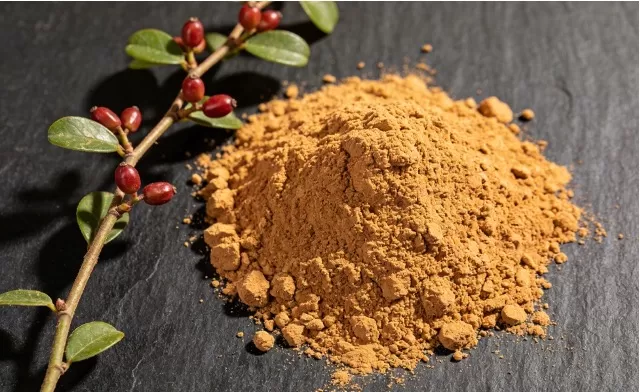
Ruscus aculeatus Extract, commonly known as butcher’s broom extract, is a traditional venotonic herb rich in steroidal saponins (ruscogenins). It is widely used to support venous and lymphatic circulation, relieve sensations of heavy legs, and reduce edema-related discomfort. With increasing demand for natural ingredients targeting microcirculation, leg comfort, and vascular health, Ruscus aculeatus Extract has become a key component in nutraceutical, pharmaceutical, and cosmetic formulations for vein and capillary support.
2. What Is Ruscus aculeatus Extract?
• Botanical Source
Ruscus aculeatus Extract is obtained from Ruscus aculeatus L. (butcher’s broom), an evergreen shrub traditionally used in Europe and the Mediterranean region to relieve symptoms related to venous insufficiency, leg swelling, and hemorrhoidal discomfort.
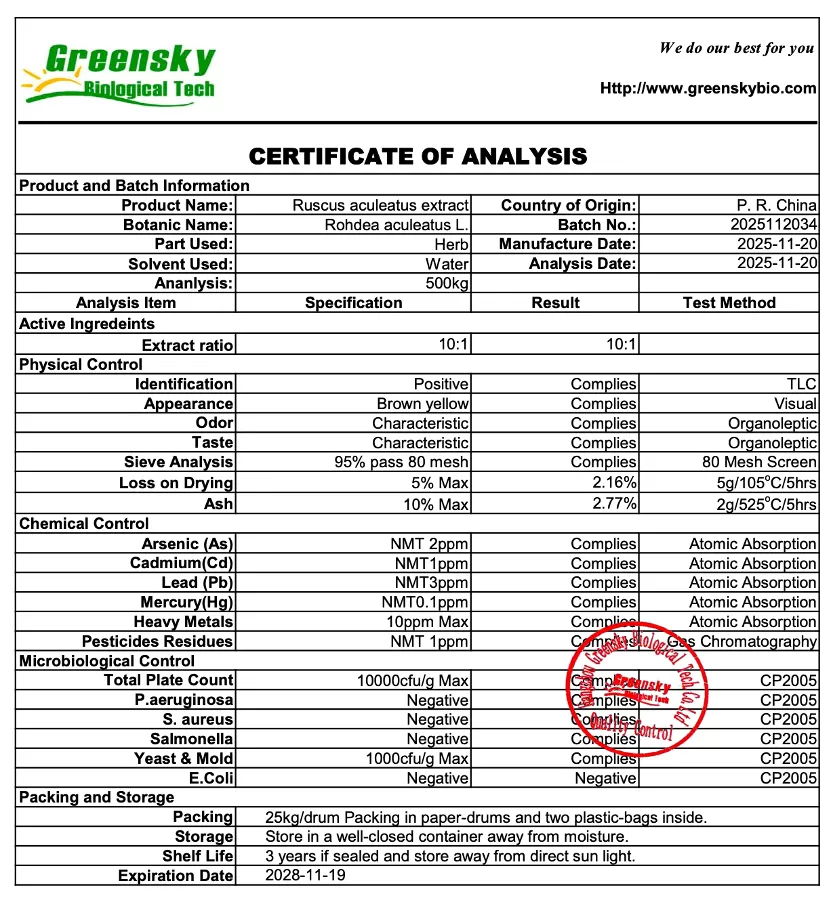
• Typical Test Methods
a) Identification: TLC
b) Heavy metals & specific elements: Atomic Absorption
c) Solvent residues: Gas Chromatography
d) Physical tests (mesh size, appearance, odor, taste): Organoleptic & sieve analysis
e) Microbiology: Standard plate count and pathogen detection methods
This combination of water extraction and rigorous analytical control ensures a clean, food-grade extract suitable for nutraceutical, food, and beverage applications.
3. Key Health Benefits & Mechanisms of Action
1) Venous Tone & Microcirculation Support
Venous Tone & Microcirculation Support
Ruscus aculeatus is considered a venotonic herb. Its main saponins (ruscogenin and neoruscogenin) promote contraction of venous smooth muscle and support venous return. Clinical trials with standardized Ruscus extract in patients with chronic venous insufficiency (CVI) have shown significant reductions in leg volume, improved venous tone, and better flow parameters compared with placebo.
Experimental work on isolated veins and human varicose vein tissue further demonstrates that Ruscus extract can constrict veins and modulate endothelial and receptor-level responses relevant to venous function.
2) Anti-edema Activity & Lymphatic Drainage
Ruscus aculeatus Extract is widely used to alleviate lower-leg edema, ankle swelling, and sensations of heaviness associated with CVI and venous-lymphatic insufficiency. Randomized, double-blind clinical studies using Ruscus-based preparations (alone or in combination with Hesperidin methyl chalcone and ascorbic acid) reported meaningful decreases in ankle and calf circumference, leg volume, and edema-related symptoms over treatment periods of 2–3 months.
These findings are consistent with pharmacopeial and regulatory assessments that recognize Ruscus aculeatus as a traditional herbal product to relieve discomfort and heaviness of the legs related to minor venous circulatory disturbances.
3) Anti-inflammatory & Diuretic Support
Preclinical studies show that crude steroidal saponins from Ruscus aculeatus rhizomes exert significant, dose-dependent anti-inflammatory and diuretic effects in animal models. These extracts reduced paw edema and increased urine output, suggesting a combined fluid-clearing and inflammation-modulating action that complements their venotonic effect.
Such mechanisms help explain the clinical observations of reduced swelling and improved comfort in patients with venous and lymphatic disorders.
4) Endothelial Protection & Antioxidant Effects
Recent phytochemical research highlights that, in addition to steroidal saponins, Ruscus aculeatus contains polyphenols with antioxidant and endothelial-protective properties. Reviews of microcirculation-targeted supplements report that Ruscus extract can help protect endothelial cells by limiting leukocyte adhesion, oxidative stress, and microvascular permeability, thereby supporting overall vascular integrity.
5) Symptomatic Relief of Heavy Legs & Hemorrhoidal Discomfort
European monographs and clinical literature support the traditional oral use of Ruscus aculeatus preparations for relieving painful, tired, and heavy legs, minor swelling, tingling, and itching related to chronic venous insufficiency, as well as itching and burning associated with hemorrhoids.
These uses align with the herb’s venotonic, anti-edema, and microcirculation-supporting profile and make it a popular choice in leg-comfort formulas and hemorrhoid relief products.
4. Applications of Ruscus aculeatus Extract
• Dietary Supplements & Nutraceuticals
a) leg-comfort and “heavy-leg” formulations
b) venous and lymphatic circulation support complexes
c) anti-swelling and water-retention control blends
d) formulas targeting sedentary lifestyles, prolonged standing, or long-distance travel
• Pharmaceuticals & Therapeutic Formulations
Standardized Ruscus preparations are used in many markets as supportive therapy for mild chronic venous insufficiency and hemorrhoids, often in combination with bioflavonoids such as Hesperidin methyl chalcone and vitamin C to enhance venous and capillary protection.
• Cosmetics & Personal Care
a) anti-puffiness eye care products
b) leg-care gels and sprays designed for tired, standing legs
c) body lotions targeting microcirculation and localized swelling
d) cosmetic formulations aimed at improving the appearance of superficial leg veins and skin comfort()
5. How to Choose a High-Quality Ruscus aculeatus Extract
• Extraction Quality
Prefer standardized extracts produced by controlled water or hydro-ethanolic extraction with validated processes.
• Safety & Purity Testing
High-quality suppliers must provide:
heavy metal analysis (As, Cd, Pb, Hg)
microbial tests (TAMC, yeast/mold, pathogens)
pesticide residue limits
solvent residue compliance
aflatoxin and PAH testing
• Certifications
Products should comply with:
GMP
ISO
COA with full test results
Allergen-free, GMO-free, additive-free status
• Stability & Quality Assurance
Ensure:
proper packaging
batch traceability
validated shelf life (typically 36 months)
6. About Us — Why Choose GreenSky Biological Technology?
With 21 years of experience in natural plant extracts, Hangzhou GreenSky Biological Technology is a trusted manufacturer supplying global food, supplement, and cosmetic brands. Established in 2004, we operate two professional factories -- a fermentation plant in Hangzhou and an extraction plant in Jiangxi — supported by a 3000+ sqm production base and a 1000 sqm fully equipped R&D center.
Our Advantages:
• Professional Expertise
Over two decades of focus on botanical extracts, delivering stable and high-grade ingredients such as Milk Thistle Extract and other functional actives.
• Reliable Quality
Strict HPLC testing, GMP-grade facilities, complete traceability, and multiple international certifications including HALAL, KOSHER, SGS, ISO, ECOCERT, BRCGS, and ISO22000.
• Flexible Customization
Support for various concentrations, purities, ratios, and particle sizes, including water-soluble forms and OEM/ODM services.
• Strong Supply Capacity
Annual output of 1000+ tons, ensuring stable and continuous supply from our Jiangxi production base and Hangzhou headquarters.
• Dedicated R&D Support
A complete laboratory system for quality testing, product development, and technical support.
7. Conclusion & Call-to-Action
Ruscus aculeatus Extract is a well-documented venotonic and microcirculation-supporting ingredient with demonstrated benefits for venous tone, edema reduction, endothelial protection, and symptomatic relief of heavy legs and hemorrhoidal discomfort. Combined with rigorous quality control and flexible formulation options, it offers brand owners a powerful natural solution for leg-comfort, vascular-health, and cosmetic applications.
Looking to expand your portfolio with evidence-based plant ingredients? Our Ruscus aculeatus extract is manufactured under strict quality systems and supported by up-to-date scientific literature.
Contact us for a FREE SAMPLE and a competitive quotation.
Our technical team will help you integrate Ruscus aculeatus extract into your formulations and design solutions tailored to your market and application.
References
Vanscheidt W, Jost V, Wolna P, et al. Efficacy and safety of a Butcher’s broom preparation (Ruscus aculeatus L. extract) compared to placebo in patients suffering from chronic venous insufficiency. Arzneimittelforschung. 2002;52(4):243–250. doi:10.1055/s-0031-1299887.
Cappelli R, Nicora M, Di Perri T. Use of extract of Ruscus aculeatus in venous disease in the lower limbs. Drugs Exp Clin Res. 1988;14(4):277–283.
Parrado F, Buzzi A. A study of the efficacy and tolerability of a preparation containing Ruscus aculeatus in the treatment of chronic venous insufficiency of the lower limbs. Clin Drug Investig. 1999;18(4):255–261.
Pacuła W, Sowa I, Feldo M, et al. Current insights into the phytochemistry and pharmacological properties of Ruscus aculeatus. Molecules. 2025;30(22):4417.
Voștinaru O, Balica G, Crișan G, et al. Diuretic and anti-inflammatory effects of a crude steroidal saponin from the rhizomes of Ruscus aculeatus L. in rats. Farmacia. 2017;65(3):467–471.
Rauly-Lestienne I, Heusler P, Cussac D, et al. Contribution of muscarinic receptors to in vitro and in vivo effects of Ruscus extract. Microvasc Res. 2017;114:1–11.
Raposo A, Saraiva A, Ramos F, et al. The role of food supplementation in microcirculation – a comprehensive review. Biology. 2021;10(7):616.
EMA Committee on Herbal Medicinal Products. European Union herbal monograph on Ruscus aculeatus L., rhizoma. European Medicines Agency; 2018.
Urbanek T. The clinical efficacy of Ruscus aculeatus extract: is there enough evidence to update the pharmacotherapy guidelines for chronic venous disease? Phlebological Review. 2017;25(1):75–80.
Rodrigues JPB, Fernandes Â, Dias MI, et al. Phenolic compounds and bioactive properties of Ruscus aculeatus L. (Asparagaceae): the pharmacological potential of an underexploited subshrub. Molecules. 2021;26(7):1882.
Test report
- ▶ Hesperidin
- ▶ Citrus Bioflavonoids
- ▶ Plant Extract
- ▶ lycopene
- ▶ Diosmin
- ▶ Grape seed extract
- ▶ Sea buckthorn Juice Powder
- ▶ Fruit Juice Powder
- ▶ Hops Extract
- ▶ Artichoke Extract
- ▶ Mushroom extract
- ▶ Astaxanthin
- ▶ Green Tea Extract
- ▶ Curcumin
- ▶ Horse Chestnut Extract
- ▶ Other Product
- ▶ Boswellia Serrata Extract
- ▶ Resveratrol
- ▶ Marigold Extract
- ▶ Grape Leaf Extract
- ▶ New Product
- ▶ Aminolevulinic acid
- ▶ Cranberry Extract
- ▶ Red Yeast Rice
- ▶ Red Wine Extract
- ▶ blog
-
Cocoa Extract
2026-02-10
-
White Peony Extract
2026-02-10
-
Licorice Root Extract Powder
2026-02-10
-
Withania Somnifera Extract
2026-02-10
-
Astaxanthin
2026-02-10
-
Mangosteen extract powder
2026-02-10
-
Lavender Extract
2026-02-10
-
Mulberry Extract
2026-02-10
-
Dandelion Leaf Extract
2026-02-10
-
Kupilu Extract
2026-02-10