- 0086-571-85302990
- [email protected]





Diosmin Complete Guide
2026-09-13
Introduction
Diosmin is a naturally occurring flavonoid glycoside found primarily in citrus fruits, particularly in the albedo (white inner layer) of oranges, lemons, and grapefruits. First isolated in 1925 from Scrophularia nodosa and later identified in citrus species, Diosmin has become one of the most extensively studied and clinically validated natural compounds for vascular health. With over 50 years of clinical research supporting its efficacy, Diosmin is widely prescribed in Europe as a phlebotonic agent and is increasingly recognized worldwide as a premium natural ingredient for venous and lymphatic health.
The global diosmin market is projected to grow significantly as consumers seek evidence-based natural alternatives for chronic venous insufficiency (CVI), hemorrhoidal disease, and microcirculation disorders. This comprehensive guide covers the science, benefits, applications, and sourcing considerations for premium diosmin extract.
Part 1: What Is Diosmin?
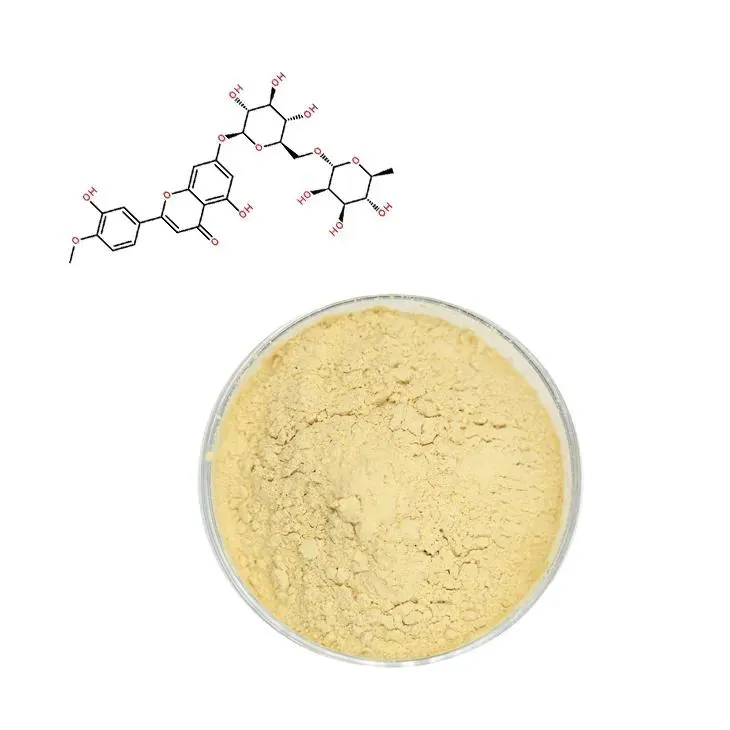
Chemical & Botanical Profile
| Attribute | Details |
|---|---|
| Chemical Name | Diosmin (7-[[6-O-(6-deoxy-α-L-mannopyranosyl)-β-D-glucopyranosyl]oxy]-5-hydroxy-2-(4-hydroxyphenyl)-4H-1-benzopyran-4-one) |
| Molecular Formula | C₂₈H₃₂O₁₅ |
| Molecular Weight | 608.54 g/mol |
| CAS Number | 520-27-4 |
| Appearance | Light yellow to yellow crystalline powder |
| Natural Source | Citrus fruits (orange, lemon, grapefruit albedo) |
| Structural Class | Flavone glycoside (diosmetin + rutinose sugar moiety) |
Relationship Between Diosmin and Hesperidin
Diosmin is often discussed alongside Hesperidin, another citrus flavonoid. The two compounds are structurally related:
Hesperidin is a flavanone glycoside (the reduced form)
Diosmin is a flavone glycoside (the oxidized form, with a C2-C3 double bond)
In the body, diosmin is metabolized to diosmetin by intestinal bacteria, which is the primary active form. Most clinical studies use a 90% diosmin + 10% hesperidin combination (known as MPFF — Micronized Purified Flavonoid Fraction), which has been shown to be more effective than either compound alone.
Standard Specifications
| Specification | Details |
|---|---|
| Purity | 95%, 98% (HPLC) |
| Appearance | Light yellow to yellow crystalline powder |
| Particle Size | Micronized (< 2 μm) or standard |
| Assay Method | HPLC |
| Solubility | Practically insoluble in water; soluble in DMSO, alkaline solutions |
| Melting Point | 275–278°C |
| Shelf Life | 36 months (cool, dry storage) |
Quality Testing Parameters
| Test Parameter | Specification |
|---|---|
| Diosmin Content (HPLC) | ≥ 95% or ≥ 98% |
| Hesperidin Content | ≤ 3% (for high-purity grades) |
| Loss on Drying | ≤ 5.0% |
| Ash | ≤ 1.0% |
| Heavy Metals (Pb, As, Cd, Hg) | ≤ 10 ppm total |
| Residual Solvents | ICH Q3C compliant |
| Total Plate Count | ≤ 1,000 CFU/g |
| Yeast & Mold | ≤ 100 CFU/g |
| E. coli / Salmonella | Negative |
Part 2: Core Benefits & Mechanisms of Action
1. Chronic Venous Insufficiency (CVI) Management
Diosmin is the most extensively studied natural compound for CVI, a condition affecting approximately 40% of adults in Western countries. Its mechanisms include:
Venotonic action: Increases venous tone by prolonging the vasoconstrictor effect of norepinephrine on vein walls
Capillary protection: Reduces capillary permeability and fragility, preventing fluid leakage into surrounding tissues
Anti-inflammatory action: Inhibits leukocyte activation, adhesion, and migration — key processes in venous wall inflammation
Lymphatic drainage: Enhances lymphatic capillary density and contractility, improving interstitial fluid removal
The landmark RELIEF Study (Randomized, Double-blind, Placebo-controlled) demonstrated that MPFF (90% diosmin + 10% hesperidin) significantly reduced leg pain, heaviness, swelling, and cramps in CVI patients over 6 months of treatment.
Reference: Nicolaides, A. N., et al. (2003). Management of chronic venous insufficiency. International Angiology, 22(2), 1–60.
2. Hemorrhoidal Disease Treatment
Diosmin is a first-line conservative treatment for hemorrhoidal disease, supported by multiple meta-analyses:
Acute hemorrhoidal attacks: High-dose diosmin (3,000 mg/day for 4 days, then 2,000 mg/day for 3 days) significantly reduces pain, bleeding, and swelling within 48 hours
Prevention of recurrence: Maintenance dosing (1,000 mg/day) reduces the frequency and severity of hemorrhoidal episodes by up to 50%
Post-surgical recovery: Accelerates healing after hemorrhoidectomy and reduces postoperative complications
A Cochrane Review (2020) confirmed that phlebotonic agents including diosmin significantly improve symptoms of hemorrhoidal disease compared to placebo.
Reference: Alonso-Coello, P., et al. (2020). Phlebotonics for haemorrhoids. Cochrane Database of Systematic Reviews.
3. Lymphedema Support
Diosmin enhances lymphatic function through:
Increasing the frequency and amplitude of lymphatic vessel contractions
Promoting lymphatic capillary neoformation in damaged tissues
Reducing interstitial protein concentration and fluid volume
Improving lymphatic transport capacity in secondary lymphedema
4. Microcirculation Enhancement
Beyond large veins, diosmin protects the microvascular network:
Reduces capillary hyperpermeability in diabetic microangiopathy
Improves retinal microcirculation in early diabetic retinopathy
Enhances skin microvascular perfusion, supporting wound healing and tissue oxygenation
Protects against venous leg ulcers by improving pericapillary fibrinolytic activity
Reference: Rabe, E., et al. (2011). Efficacy of micronized purified flavonoid fraction in chronic venous disease. Phlebology, 26(1), 3–14.
5. Anti-Inflammatory & Antioxidant Properties
Diosmin exhibits broad anti-inflammatory activity:
Inhibits prostaglandin E2 (PGE2) and thromboxane A2 production
Suppresses free radical generation by activated leukocytes
Reduces expression of adhesion molecules (ICAM-1, VCAM-1) on endothelial cells
Inhibits phosphodiesterase activity, increasing intracellular cAMP levels
Part 3: Wide-Ranging Application Fields
Pharmaceuticals
Venotonic tablets — Standard 500 mg diosmin tablets for CVI treatment (prescription-grade in many European countries)
Hemorrhoid treatment — Acute-dose sachets and maintenance tablets
Combination products — Diosmin + hesperidin (MPFF) for synergistic vascular benefits
Topical formulations — Creams and gels for localized venous discomfort
Dietary Supplements & Nutraceuticals
Vein health capsules — 250–500 mg daily dose supplements targeting the growing CVI market
Leg health formulas — Combined with horse chestnut extract, butcher's broom, and grape seed extract
Circulation support — Blended with vitamin C, bioflavonoids, and rutin
Women's health — Targeted formulations for pregnancy-related venous discomfort
Functional Foods & Beverages
Vascular health drinks — Functional beverages with micronized diosmin
Health bars — Venous-support snack bars for active professionals
Cosmetics & Personal Care
Anti-cellulite creams — Diosmin improves microcirculation in subcutaneous tissue
Under-eye treatments — Reduces dark circles caused by poor microcirculation
Leg gels — Cooling formulations for tired, heavy legs
Anti-redness skincare — Calms rosacea and couperose skin by strengthening capillary walls
Veterinary Applications
Equine leg health — Venous support for performance horses
Canine vascular health — Support for aging dogs with circulatory issues
Part 4: Key Factors in Choosing High-Quality Diosmin
1. Purity & Standardization
Premium diosmin should be:
≥ 95% or ≥ 98% purity verified by HPLC
Low hesperidin content (< 3%) for high-purity grades, unless a specific diosmin/hesperidin ratio is required
Batch-specific chromatograms available upon request
2. Micronization
Micronized diosmin (particle size < 2 μm) offers significantly improved bioavailability:
2× higher absorption compared to non-micronized forms
Faster onset of action
More consistent therapeutic effects
This is the form used in all major clinical trials
3. Source & Manufacturing
The highest-quality diosmin is:
Extracted from citrus fruits (not chemically synthesized from diosmetin)
Manufactured under GMP conditions with full traceability
Processed using environmentally responsible extraction methods
4. Regulatory Documentation
Ensure your supplier provides:
DMF (Drug Master File) for pharmaceutical applications
GRAS documentation for US supplement market
Novel Food compliance for EU market
CEP (Certificate of Suitability) for European Pharmacopoeia compliance
Full pharmacopeial compliance (USP, EP, ChP as applicable)
5. Stability & Shelf Life
Quality diosmin should demonstrate:
36-month stability at room temperature
Consistent potency throughout shelf life
Proper packaging (moisture-barrier bags, sealed drums)
Part 5: Why Choose Greensky Bio as Your Diosmin Supplier
As a leading natural plant extract manufacturer with over 20 years of expertise, delivers premium diosmin that meets the highest pharmaceutical and nutraceutical standards:
Multiple purity grades — 95% and 98% HPLC-verified diosmin, plus custom diosmin/hesperidin ratios (90:10, 45:45, etc.)
Micronized options — Ultra-fine particle size (< 2 μm) for maximum bioavailability
GMP-certified facilities — ISO 22000, HACCP, SGS-GMP, Kosher, and Halal certified
Complete documentation — COA, MSDS, DMF support, TSE/BSE-free statement, allergen declaration
Citrus-sourced — Natural extraction from premium citrus fruits, not synthetic production
Competitive pricing — Direct manufacturer pricing with volume discounts
Global regulatory support — Registration assistance for US, EU, Asian, and other international markets
Conclusion
Diosmin stands as one of the most clinically validated natural compounds for vascular health. With decades of research supporting its efficacy in managing chronic venous insufficiency, hemorrhoidal disease, lymphedema, and microcirculation disorders, diosmin represents a cornerstone ingredient for pharmaceutical companies and supplement manufacturers targeting the rapidly growing vascular health market.
Its multi-target mechanism — combining venotonic, anti-inflammatory, capillary-protective, and lymphatic-enhancing actions — makes diosmin uniquely effective among natural vascular health ingredients.
Interested in Diosmin? today for:
Latest pricing and volume discounts
Free samples for evaluation
Custom specification development (purity, micronization, ratios)
Full technical documentation and regulatory support
- ▶ Hesperidin
- ▶ Citrus Bioflavonoids
- ▶ Plant Extract
- ▶ lycopene
- ▶ Diosmin
- ▶ Grape seed extract
- ▶ Sea buckthorn Juice Powder
- ▶ Fruit Juice Powder
- ▶ Hops Extract
- ▶ Artichoke Extract
- ▶ Mushroom extract
- ▶ Astaxanthin
- ▶ Green Tea Extract
- ▶ Curcumin
- ▶ Horse Chestnut Extract
- ▶ Other Product
- ▶ Boswellia Serrata Extract
- ▶ Resveratrol
- ▶ Marigold Extract
- ▶ Grape Leaf Extract
- ▶ New Product
- ▶ Aminolevulinic acid
- ▶ Cranberry Extract
- ▶ Red Yeast Rice
- ▶ Red Wine Extract
- ▶ blog
-
Boswellia Serrata Extract
2026-09-13
-
Apricot Powder
2026-09-13
-
Shikonin
2026-09-13
-
Ginger Extract
2026-09-13
-
5-HTP (5-Hydroxytryptophan)
2026-09-13
-
Baobab Fruit Extract
2026-09-13
-
Beetroot juice Powder
2026-09-13
-
Carrageenan Extract Powder
2026-09-13
-
Fig Extract
2026-09-13
-
Lemon Extract
2026-09-13