- 0086-571-85302990
- [email protected]




Ivy Extract
2026-03-25
Ivy Extract
Introduction
If you’ve ever reached for a herbal cough syrup during a nasty cold, chances are you’ve already encountered Ivy Extract without knowing it. This climbing plant, often seen covering walls and trees across Europe and Asia, has quietly become one of the most researched and trusted natural ingredients in respiratory health. But here’s the thing—what makes Ivy Extract genuinely fascinating isn’t just its traditional use, but the growing body of modern science that’s figuring out exactly how it works. Whether you’re formulating a new dietary supplement, developing a clean-label cough syrup, or exploring natural actives for skincare, understanding Ivy Extract inside and out can make a real difference in your product development. Let’s dive into everything you need to know.
Part 1: What Exactly Is Ivy Extract?
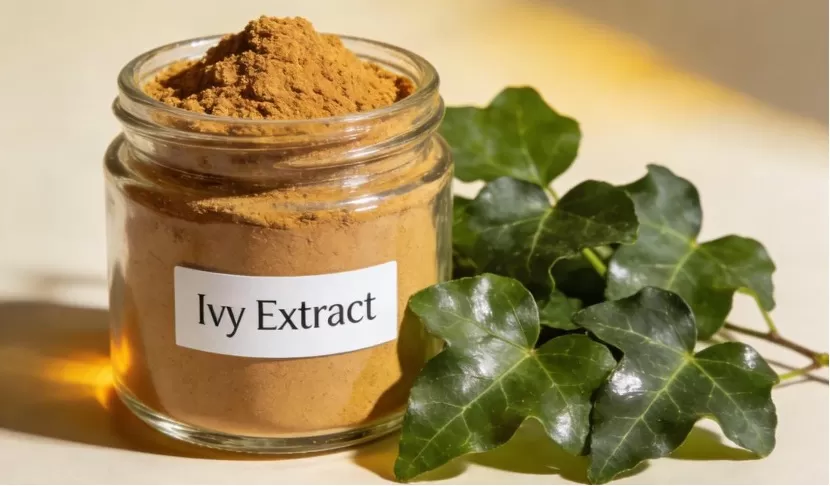
Let’s start with the basics. Ivy Extract comes from the leaves of Hedera helix, a member of the Araliaceae family. You might know it as common ivy, English ivy, or European ivy. It’s native to Europe, western Asia, and northern Africa, though you’ll now find it growing in temperate regions worldwide. For centuries, folk medicine practitioners used ivy leaves for respiratory conditions, but it’s only in recent decades that we’ve really understood what’s happening at the molecular level.
The active components are where things get interesting. Ivy leaves contain a complex mixture of bioactive compounds, but the stars of the show are the triterpene saponins—specifically hederacoside C and alpha-hederin. These are typically the marker compounds used to standardize commercial extracts. Beyond saponins, ivy leaves also contain flavonoids (including rutin and kaempferol), phenolic acids (chlorogenic acid, caffeic acid), and sterols .
Our standard specifications typically include:
l Hederacoside C: 5%–20% (by HPLC)
l Alpha-hederin: 1%–5%
l Extraction solvent: Ethanol 30%–70% or water
l Particle size: 100% through 80 mesh
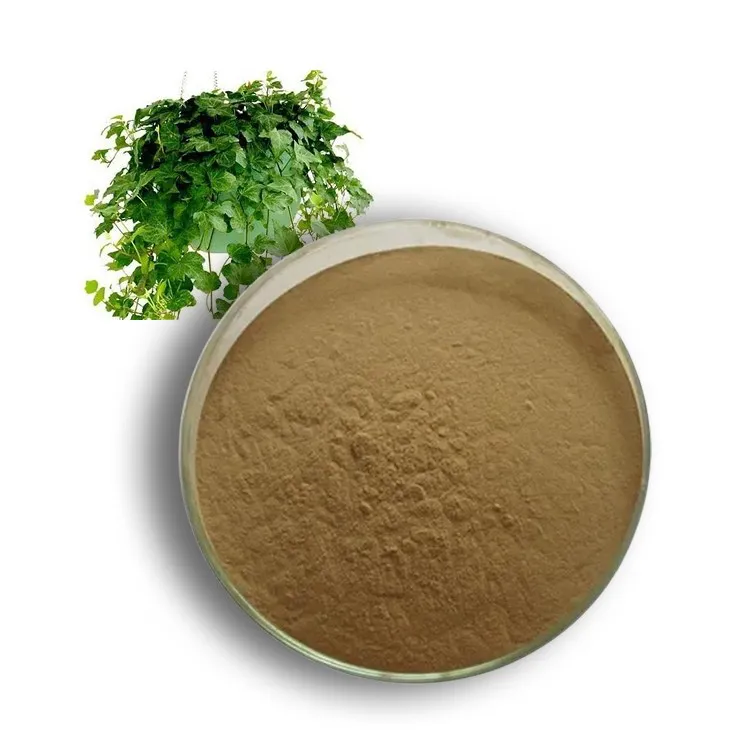
l Appearance: Brown-yellow fine powder
l Loss on drying: ≤5.0%
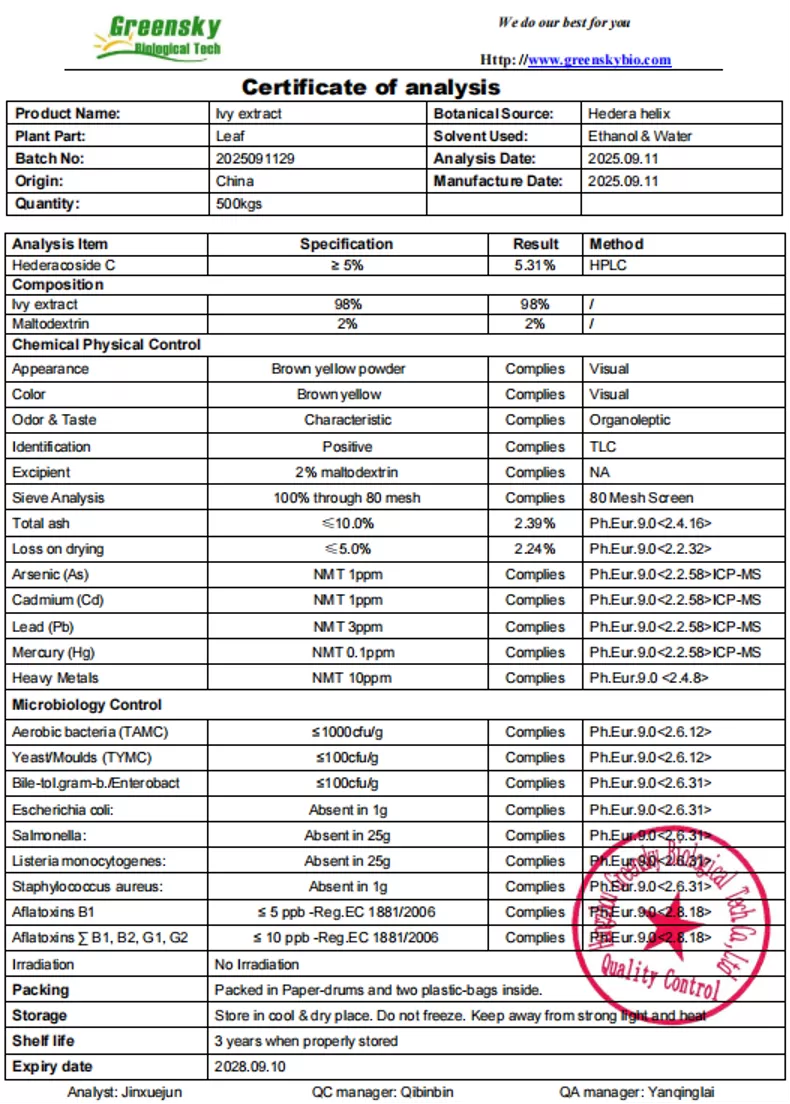
Our in-house testing goes beyond just marker compounds. Every batch undergoes rigorous analysis for heavy metals, microbiological contaminants, and solvent residues. We also run HPLC fingerprinting to ensure consistency with reference standards—because nature varies, but your formulations shouldn’t have to.
Part 2: Core Benefits and What the Science Actually Says
This is the part I find genuinely exciting. Ivy Extract isn’t just “traditional”—there’s real mechanistic research backing its effects.
Respiratory Support and Mucolytic Activity
The most well-documented benefit of Ivy Extract is its ability to support respiratory health, particularly in managing cough and mucus. The mechanism? Ivy saponins—especially alpha-hederin—have been shown to increase beta-2 adrenergic receptor sensitivity in the lungs. This leads to bronchodilation and reduced viscosity of mucus, making it easier to clear . A 2023 review of pediatric studies confirmed that ivy leaf dry extract EA 575 (a standardized formulation) improved lung function and subjective cough symptoms in children, with a notably low incidence of adverse events .
Anti-Inflammatory Effects
Inflammation drives many respiratory symptoms, and Ivy Extract appears to help here too. A 2022 study using a mouse model of acute lung injury found that ivy leaf extract significantly reduced pro-inflammatory cytokines including TNF-α, IL-1β, and IL-6. Interestingly, the phenolic-rich fraction showed even stronger activity than the saponin fraction, suggesting that the whole extract may work better than isolated compounds . The extract also inhibited COX-2 expression, a key player in the inflammatory cascade.
Antioxidant Protection
Oxidative stress goes hand-in-hand with inflammation. Research published in 2024 demonstrated that ivy leaf extracts possess significant free radical scavenging activity, with IC50 values comparable to standard antioxidants. The leaf extract showed particular potency in ABTS assays, indicating its ability to neutralize multiple types of free radicals .
Antimicrobial Properties
The same 2024 study also evaluated antimicrobial activity. Ivy leaf extract showed inhibitory effects against various pathogens, adding another layer to its respiratory benefits . While it shouldn’t replace antibiotics in serious infections, this activity may help support overall respiratory health.
Emerging Research: Gastrointestinal Applications
Here’s something you might not know: traditional use of ivy included gastrointestinal complaints, and modern research is catching up. A study published in Farmacia found that ivy leaf extract possesses antidiarrheal and antispasmodic effects in animal models, likely through calcium channel blockade—similar to how some prescription drugs work for hyperactive gut disorders . While more research is needed, this opens interesting possibilities for digestive health applications.
What the Clinical Trials Show
A 2025 head-to-head clinical trial compared ivy extract alone against combinations with thyme and primrose in patients with acute bronchitis. The results? Ivy extract alone was non-inferior to both combinations—meaning it worked just as well—and actually showed statistically superior efficacy compared to the ivy-thyme combination. Patients taking ivy extract alone also reached clinically meaningful improvement faster (by day 2 versus day 3 for combinations) . This matters because it suggests that well-formulated single extracts can be just as effective as complex blends, simplifying formulation challenges.
Another large database analysis from 2025 involving over 10,000 children found that prescribing ivy extract EA 575 was associated with significantly lower subsequent antibiotic use compared to those initially prescribed antibiotics. The odds of antibiotic prescription were reduced by 44% in the 4–30 days following ivy extract use . That’s a meaningful real-world outcome.
Part 3: Where Ivy Extract Is Used Today
Understanding the science is one thing—knowing where your product fits in the market is another. Here’s where Ivy Extract is making an impact.
Pharmaceuticals and Dietary Supplements
This remains the largest application. Ivy extract is widely used in cough syrups, lozenges, and tablets targeting respiratory health. The European Medicines Agency has recognized its use as an expectorant for productive cough, and it appears in pharmacopeias across Europe and Asia. For supplement manufacturers, it’s a go-to ingredient for respiratory wellness formulas.
Functional Foods and Beverages
We’re seeing growing interest in incorporating herbal extracts into everyday products. Ivy extract can be formulated into throat-soothing teas, functional gummies, and even effervescent tablets. The challenge is masking its characteristic bitterness, but modern taste-masking technologies make this manageable.
Cosmetics and Personal Care
Given its antioxidant and anti-inflammatory profile, ivy extract is finding its way into skincare. It appears in creams and serums targeting sensitive or reactive skin, as well as products claiming soothing benefits. The 2024 wound-healing study mentioned earlier showed that ivy extract accelerated wound contraction in experimental models—95.82% contraction compared to 81.12% for the control . While human studies are needed, this points to potential in topical applications.
Animal Nutrition
The pet humanization trend means high-quality natural ingredients are moving into animal health. Ivy extract is being explored as a respiratory support ingredient for horses, dogs, and even poultry, where respiratory challenges can impact performance.
Part 4: How to Choose a Quality Ivy Extract
Not all ivy extracts are created equal. Here’s what I’ve learned about separating premium ingredients from ordinary ones.
Start with the source. Ivy leaves should be harvested from clean, uncontaminated sites. European-grown material typically offers better traceability.
Check the standardization. A good supplier will provide certificates of analysis showing both hederacoside C and alpha-hederin content. These should match labeled specifications batch after batch.
Understand the extraction process. Ethanol-based extraction (typically 30%–70% ethanol) preserves the full spectrum of actives. Water-only extracts may have different profiles. CO2 extracts exist but are less common for ivy.
Request the data. A confident supplier shares third-party testing results, not just in-house numbers. Look for pesticide screens, heavy metal analyses, and microbiological reports.
Ask about the extraction ratio. Drug-to-extract ratios (like 5–7.5:1) tell you how concentrated the product is. The well-studied EA 575 extract, for example, uses a 5–7.5:1 ratio with 30% ethanol .
Part 5: Who We Are and Why It Matters
At Greensky , we’ve been working with plant extracts long enough to know that consistency is everything. Our ivy extract starts with carefully selected raw material from trusted growing regions. We test at multiple points—raw material, in-process, and finished product—to ensure every batch meets your specifications.
We offer customizable standardization to fit your formulation needs, whether you require 5% or 20% hederacoside C. Our extracts are produced in GMP-compliant facilities, and we provide comprehensive documentation for every shipment. If you’re developing a new product and need technical support, our team has the experience to help you navigate formulation challenges.
Part 6: Bringing It All Together
Ivy Extract sits at an interesting intersection: deeply rooted in traditional use, yet increasingly validated by modern science. From reducing antibiotic use in children with colds to outperforming combination products in clinical trials, the evidence supporting this ingredient continues to grow . Whether you’re formulating for respiratory health, exploring topical applications, or developing functional foods, ivy extract offers versatility backed by real data.
If you’re curious about how our ivy extract might work in your products—or if you just want to compare specifications—we’d love to hear from you. We offer free samples for qualified buyers and technical support to help you get your formulation right. Reach out today for a quote or to request documentation. Let’s build something better, together.
References
1. The Impact of Ivy Leaf Dry Extract EA 575 on Subsequent Antibiotic Use in Children and Adolescents with the Common Cold. Children. 2025;12(4):518.
2. Al-jaafreh AM. Anti-inflammatory, Antioxidant, and Wound-healing Properties of the Methanolic Extracts from Hedera helix Fruits and Leaves. Biomedical and Pharmacology Journal. 2024;17(2):1091-1102.
3. Efficacy and Safety of a Single Ivy Extract Versus Two Herbal Extract Combinations in Patients with Acute Bronchitis: A Multi-Center, Randomized, Open-Label Clinical Trial. Pharmaceuticals. 2025;18(5):754.
4. Shah AJ, Khan M, Ahmad M, Sher H. Voltage-dependent Ca2+ entry blocking activity of Hedera helix leaf extract explains its medicinal use in hyperactive gut disorders. Farmacia. 2018;66(1).
5. Seifert G, Upstone L, Watling CP, Vogelberg C. Ivy leaf dry extract EA 575 for the treatment of acute and chronic cough in pediatric patients: review and expert survey. Current Medical Research and Opinion. 2023;39(10):1407-1417.
6. Bioactive phenolics fraction of Hedera helix L. (Common Ivy Leaf) standardized extract ameliorates LPS-induced acute lung injury in the mouse model through the inhibition of proinflammatory cytokines and oxidative stress. ScienceOpen. 2022.
TEST REPORT
- ▶ Hesperidin
- ▶ Citrus Bioflavonoids
- ▶ Plant Extract
- ▶ lycopene
- ▶ Diosmin
- ▶ Grape seed extract
- ▶ Sea buckthorn Juice Powder
- ▶ Fruit Juice Powder
- ▶ Hops Extract
- ▶ Artichoke Extract
- ▶ Mushroom extract
- ▶ Astaxanthin
- ▶ Green Tea Extract
- ▶ Curcumin
- ▶ Horse Chestnut Extract
- ▶ Other Product
- ▶ Boswellia Serrata Extract
- ▶ Resveratrol
- ▶ Marigold Extract
- ▶ Grape Leaf Extract
- ▶ New Product
- ▶ Aminolevulinic acid
- ▶ Cranberry Extract
- ▶ Red Yeast Rice
- ▶ Red Wine Extract
- ▶ blog
-
Oat Straw Extract Powder
2026-03-25
-
Troxerutin
2026-03-25
-
Red Vine Extract
2026-03-25
-
Liposomal Berberine HCl
2026-03-25
-
Lotus leaf extract
2026-03-25
-
Curcumin
2026-03-25
-
Konjac Powder
2026-03-25
-
Yohimbine Bark Extract
2026-03-25
-
Yellow Pine Extract
2026-03-25
-
Calendula Extract
2026-03-25