- 0086-571-85302990
- [email protected]






Rhodiola Rosea Extract Complete Guide: Adaptogenic Powerhouse, Applications & Supplier Guide
2026-08-07
Meta Description: Discover everything about Rhodiola Rosea Extract (standardized to 3% Rosavins + 1% Salidroside) — from its clinically-proven adaptogenic, anti-fatigue, and cognitive-enhancing mechanisms to applications in nutraceuticals, sports nutrition, and cosmeceuticals. Greensky Bio, your trusted Rhodiola extract partner.
Meta Keywords: rhodiola rosea extract, rosavins, salidroside, adaptogen supplement, anti-fatigue, Rhodiola 3% rosavins 1% salidroside, cognitive enhancer, stress management, Siberian ginseng, China rhodiola extract supplier
URL Slug: /plant_extract/rhodiola-rosea-extract-adaptogen-complete-guide.html
Target Keywords:
Primary: "rhodiola rosea extract", "rosavins 3% salidroside 1%", "adaptogen supplement"
Secondary: "rhodiola anti-fatigue", "Rhodiola cognitive enhancer", "golden root extract"
Long-tail: "rhodiola rosea extract 3% rosavins 1% salidroside supplier", "adaptogenic herb for stress management supplements", "rhodiola extract for mental performance capsules"
1. Introduction
For over 3,000 years, the peoples of Siberia, Mongolia, and the high-altitude regions of Central Asia have revered Rhodiola rosea — known colloquially as "Golden Root" — as a vital adaptogenic herb that enhances physical endurance, mental clarity, and resilience to environmental stress. In traditional Chinese medicine and Russian folk medicine alike, it was the go-to botanical for survival in harsh climates. Modern pharmacological research has now validated this ancient wisdom: the unique combination of rosavins and salidroside in Rhodiola rosea root exerts multi-target adaptogenic effects, modulating the hypothalamic-pituitary-adrenal (HPA) axis, enhancing cellular energy metabolism, and protecting against stress-induced neurodegeneration. Today, standardized Rhodiola rosea extract (3% rosavins + 1% salidroside) is one of the fastest-growing ingredients in the global adaptogen and nootropic markets, with the adaptogen segment projected to reach USD 13.4 billion by 2030.
Hangzhou Greensky Biological Tech Co., Ltd — a professional natural plant extract manufacturer established in 2004 — offers premium standardized Rhodiola rosea extract with verified rosavin and salidroside content, backed by ISO22000, BRCGS, Ecocert Organic, and SGS-GMP certifications.
2. What Is Rhodiola Rosea Extract?
Rhodiola rosea extract is a standardized botanical preparation derived from the dried roots and rhizomes of Rhodiola rosea L., a perennial plant belonging to the Crassulaceae (stonecrop) family. The extract concentrates the pharmacologically active phenylpropanoids (rosavins) and phenylethanoids (salidroside) into a consistent, potent powder.
2.1 Botanical Information
| Item | Details |
|---|---|
| Latin Name | Rhodiola rosea L. |
| Family | Crassulaceae (Stonecrop family) |
| Source Plant | Rhodiola rosea (Golden Root, Arctic Root, Siberian Ginseng) |
| Main Growing Regions | Siberia (Altai Mountains), Central Asia (Xinjiang, Tibet), Scandinavia, Bulgaria, Caucasus Mountains |
| Extraction Part | Root and rhizome (harvested from plants ≥ 3 years old) |
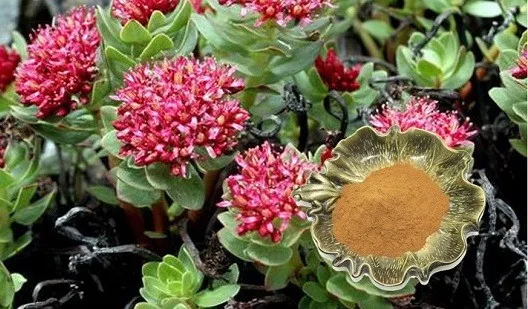
| Appearance | Light brown to yellowish-brown fine powder |
| Odor | Characteristic rose-like aroma (hence the name "rosea") |
Sustainability note: Rhodiola rosea is listed as a vulnerable species in several regions due to overharvesting. Responsible sourcing — including cultivation programs and wild-harvest permits with replanting requirements — is essential for long-term supply sustainability.
2.2 Key Active Compounds
The pharmacological activity of Rhodiola rosea is attributed to two primary groups of bioactive compounds:
| Compound | Class | Typical Content | Pharmacological Significance |
|---|---|---|---|
| Rosavin | Phenylpropanoid glycoside | ≥ 1.5% | Marker compound unique to R. rosea; anti-stress, anti-depressant |
| Rosin | Phenylpropanoid | ≥ 0.5% | Complementary rosavin-class compound |
| Rosarin | Phenylpropanoid | ≥ 0.5% | Contributes to total rosavin activity |
| Total Rosavins | Phenylpropanoids | ≥ 3.0% | Standardized marker (European Pharmacopoeia requirement) |
| Salidroside (Rhodioloside) | Phenylethanoid glycoside | ≥ 1.0% | Key anti-fatigue, neuroprotective, and immunomodulatory agent |
| Tyrosol | Phenylethanoid | 0.1-0.3% | Metabolite of salidroside; antioxidant activity |
The Rosavin-Salidroside Synergy: Rosavins and salidroside work through complementary but distinct mechanisms. Rosavins primarily modulate the HPA axis and monoamine neurotransmitter systems (serotonin, dopamine, norepinephrine), while salidroside exerts direct cellular protective effects — activating AMPK, enhancing mitochondrial function, and upregulating heat shock proteins. Together, they provide the comprehensive adaptogenic response that defines Rhodiola rosea.
2.3 Standard Specifications
| Specification | Standard |
|---|---|
| Total Rosavins (HPLC) | ≥ 3.0% |
| Salidroside (HPLC) | ≥ 1.0% |
| Moisture | ≤ 5.0% |
| Ash | ≤ 5.0% |
| Particle Size | 100% pass 80 mesh |
| Heavy Metals | ≤ 10 ppm |
| Arsenic | ≤ 1.0 ppm |
| Lead | ≤ 2.0 ppm |
| Pesticide Residues | Compliant with EU MRL |
| Microbial Count | TPC < 1,000 CFU/g |
2.4 Production Process
Raw Material Sourcing: Wild-harvested or cultivated Rhodiola rosea roots from the Altai Mountains (Siberia) and high-altitude regions of Central Asia (Xinjiang, Tibet). Roots are harvested from plants aged ≥ 3 years for optimal active compound content.
Cleaning & Drying: Roots are thoroughly cleaned, sliced, and dried at low temperature (≤ 50°C) to preserve thermolabile glycosides.
Milling: Dried roots are milled to coarse powder for efficient extraction.
Solvent Extraction: Food-grade ethanol/water mixture (50-70% ethanol) extracts rosavins and salidroside under controlled temperature (60-70°C) for 2-3 hours.
Filtration & Concentration: Extract is filtered and concentrated under vacuum at low temperature.
Spray Drying: Concentrated extract is spray-dried to produce a free-flowing powder.
Standardization: HPLC analysis for rosavin and salidroside content, with blending to achieve exact 3%/1% specifications.
Quality Testing: Full panel analysis including HPLC, heavy metals, residual solvents, pesticides, and microbiology.
2.5 Certificate of Analysis (Typical)
| Test Item | Result | Specification |
|---|---|---|
| Appearance | Light brown powder | Complies |
| Odor | Characteristic rose-like | Complies |
| Total Rosavins (HPLC) | 3.15% | ≥ 3.0% |
| Salidroside (HPLC) | 1.08% | ≥ 1.0% |
| Moisture | 4.2% | ≤ 5.0% |
| Ash | 4.5% | ≤ 5.0% |
| Lead (Pb) | < 1.0 ppm | ≤ 2.0 ppm |
| Arsenic (As) | < 0.5 ppm | ≤ 1.0 ppm |
| TPC | 450 CFU/g | < 1,000 CFU/g |
| Yeast & Mold | < 10 CFU/g | < 100 CFU/g |
| E. coli | Negative | Negative |
| Salmonella | Negative | Negative |
3. Core Health Benefits & Mechanisms of Action
3.1 Adaptogenic Stress Resistance — HPA Axis Modulation
Rhodiola rosea is classified as a true adaptogen — a substance that increases the body's non-specific resistance to physical, chemical, and biological stressors. The defining characteristic of an adaptogen, per the criteria established by Brekhman and Dardymov (1969), is that it must:
Be non-toxic at normal doses
Produce a non-specific stress response (broad-spectrum resistance)
Normalize physiological functions regardless of the direction of stress-induced changes
Rhodiola rosea meets all three criteria through its modulation of the hypothalamic-pituitary-adrenal (HPA) axis:
Reduces cortisol overproduction: Rosavins and salidroside downregulate cortisol release during acute stress, preventing the damaging effects of chronic hypercortisolemia
Stimulates stress-protective proteins: Salidroside upregulates heat shock protein 70 (Hsp70), which protects cells from stress-induced damage
Balances neurotransmitter levels: Rosavins inhibit monoamine oxidase-A (MAO-A) and monoamine oxidase-B (MAO-B), increasing the availability of serotonin, dopamine, and norepinephrine in the synaptic cleft
Key study: Darbinyan et al. (2000, Phytomedicine) conducted a double-blind, placebo-controlled trial with 56 physicians working night shifts. Those receiving 500 mg/day standardized Rhodiola extract (SHR-5) showed significantly reduced fatigue, improved cognitive function, and better work performance compared to placebo — without stimulant side effects.
3.2 Anti-Fatigue & Physical Performance Enhancement
The anti-fatigue effects of Rhodiola rosea are among its most well-documented properties:
Enhances ATP production: Salidroside activates AMP-activated protein kinase (AMPK), the cellular "energy sensor," promoting mitochondrial ATP synthesis
Improves oxygen utilization: Rhodiola enhances cellular oxygen utilization efficiency, particularly under hypoxic conditions
Reduces exercise-induced muscle damage: Antioxidant properties protect muscle tissue from exercise-induced oxidative stress
Delays central fatigue: By modulating serotonin and dopamine levels in the brain, Rhodiola delays the onset of central fatigue during prolonged exercise
Clinical evidence: In a randomized, double-blind trial (De Bock et al., 2004, Phytomedicine), healthy volunteers who received a single dose of Rhodiola extract (SHR-5, 3 mg/kg body weight) 1 hour before an endurance cycling test showed a statistically significant 3% increase in time to exhaustion (p < 0.05), with lower perceived exertion ratings.
3.3 Cognitive Enhancement & Mental Performance
Rhodiola rosea's cognitive benefits are increasingly supported by clinical evidence:
Improves attention and concentration: By maintaining optimal dopamine and norepinephrine levels in the prefrontal cortex
Enhances working memory: Salidroside's neuroprotective effects support hippocampal function
Reduces mental fatigue during prolonged cognitive tasks: Particularly relevant for students, professionals, and shift workers
May support mood and reduce mild depressive symptoms: Via serotonergic and dopaminergic modulation
Clinical evidence: Shevtsov & Halounova (2007, Phytotherapy Research) demonstrated that standardized Rhodiola extract significantly improved mental performance, attention, and cognitive function in night-duty physicians during 6-hour shifts, with effects evident within 2 hours of administration.
3.4 Immunomodulation & Antioxidant Protection
Enhances immune cell function: Salidroside stimulates natural killer (NK) cell activity and macrophage phagocytosis
Protects against oxidative stress: Both rosavins and salidroside exhibit direct free radical scavenging activity
Supports immune function during stress: Stress-induced immunosuppression is mitigated by Rhodiola's adaptogenic action
3.5 Cardioprotective Effects
Emerging research suggests Rhodiola rosea may offer cardiovascular benefits:
Salidroside protects cardiac myocytes from hypoxia/reoxygenation injury via activation of the PI3K/Akt signaling pathway
Improves exercise-induced cardiac adaptation through enhanced mitochondrial biogenesis
Anti-arrhythmic effects observed in animal models
4. Wide-Ranging Application Areas
4.1 Nutraceuticals & Dietary Supplements
Adaptogen & Stress Management Capsules: Standardized Rhodiola extract (3% rosavins + 1% salidroside) at 200-500 mg per serving, marketed for stress resilience, mental clarity, and energy support. Often combined with ashwagandha, L-theanine, or B vitamins.
Sports Nutrition & Performance Supplements: Pre-workout and endurance formulas leveraging Rhodiola's anti-fatigue and oxygen-utilization benefits. Growing segment in the athletic performance market.
Nootropic & Cognitive Enhancement Formulations: Premium brain health products combining Rhodiola with bacopa, lion's mane, and phosphatidylserine.
Mood Support Supplements: Natural mood-balancing formulas for mild stress and occasional low mood, positioned as gentle alternatives to pharmaceutical options.
4.2 Functional Foods & Beverages
Energy & focus beverages: Adaptogenic drinks featuring Rhodiola alongside guarana, ginseng, and green tea
Functional gummies: Stress-management and focus gummies for the growing wellness market
Adaptogenic coffee alternatives: Rhodiola-infused mushroom coffee blends
4.3 Cosmeceuticals & Personal Care
Anti-stress skincare: Topical formulations targeting stress-induced skin aging (cortisol-driven collagen breakdown)
Anti-fatigue eye creams: Salidroside's microcirculation-enhancing properties for under-eye dark circles
Scalp health products: Rhodiola extract in hair care formulations for stress-related hair loss prevention
4.4 Veterinary & Animal Performance
Working dog supplements: Military, police, and service dogs under high-stress conditions
Equine performance supplements: Racehorse stamina and stress resilience
Livestock stress management: During transport, weaning, and environmental changes
5. How to Choose a Premium Rhodiola Rosea Extract
5.1 Dual-Marker Standardization — The European Pharmacopoeia Standard
Authentic Rhodiola rosea extract must be standardized to both rosavins (≥ 3%) and salidroside (≥ 1%), as required by the European Pharmacopoeia monograph. This dual-marker requirement is critical because:
Rosavins are unique to R. rosea and serve as authenticity markers
Salidroside is the primary anti-fatigue and neuroprotective compound
Some other Rhodiola species (e.g., R. crenulata) contain salidroside but lack rosavins
Be wary of extracts that only test for salidroside — they may be adulterated with cheaper Rhodiola species.
5.2 Species Authentication
Rhodiola rosea is frequently adulterated with other Rhodiola species (R. crenulata, R. sachalinensis, R. kirilowii). Ensure your supplier uses:
HPLC fingerprint analysis to confirm the presence of the complete rosavin profile (rosavin, rosarin, rosin)
DNA barcoding or botanical microscopy for species identification
Clear species labeling on all documentation
5.3 Sustainable & Ethical Sourcing
Rhodiola rosea is a slow-growing, slow-maturing plant (requires 3-5 years to reach harvestable size) and is listed as vulnerable in several regions. Responsible sourcing practices include:
Cultivation programs rather than exclusive wild harvesting
Replanting commitments for wild-harvested material
Harvest permits from regional authorities
Transparency about origin and harvesting methods
5.4 Third-Party Testing & Certifications
HPLC analysis for rosavin profile AND salidroside (not just total)
Species authentication via DNA or fingerprint analysis
Heavy metals, pesticides, mycotoxins screening
Certifications: ISO22000, GMP, Organic, Halal, Kosher
5.5 Extraction Quality
Premium extraction uses controlled ethanol/water extraction at moderate temperatures (60-70°C). Excessive heat can degrade the glycosidic bonds in rosavins and salidroside, reducing potency.
6. About Greensky Biochem — Your Trusted Rhodiola Partner
Hangzhou Greensky Biological Tech Co., Ltd, established in 2004, is a leading natural plant extract manufacturer specializing in standardized botanical extracts for the global nutraceutical, food, cosmetic, and pharmaceutical industries.
Our Rhodiola Rosea Extract advantage:
Dual-Marker Verified: Every batch HPLC-tested for both total rosavins (≥ 3%) AND salidroside (≥ 1%) — meeting European Pharmacopoeia standards
Authentic Species: DNA-verified Rhodiola rosea L. raw material — no adulteration with other Rhodiola species
Sustainable Sourcing: Direct partnerships with cultivation programs in Siberia and high-altitude regions of China (Xinjiang, Tibet), ensuring ethical and sustainable supply
Full Spectrum Certifications: ISO22000, BRCGS (Grade AA), Ecocert Organic, SGS-GMP, Halal, Kosher, FDA Registered
Customization: Multiple specification options (1%, 3%, 5% rosavins; 0.5%, 1%, 3% salidroside), custom extraction ratios (3:1, 5:1, 10:1), and private label support
Global Export Experience: Serving 40+ countries with reliable supply, competitive pricing, and responsive technical support
In-House R&D: Our laboratory continuously optimizes extraction protocols to maximize both rosavin and salidroside yield while preserving the natural compound ratio
Whether you're developing a premium adaptogen capsule, a nootropic brain health formula, or a sports nutrition performance enhancer, our team provides technical formulation support, regulatory guidance, and consistent quality you can rely on.
7. Conclusion & Call to Action
Rhodiola rosea extract stands at the intersection of ancient wisdom and modern science — an adaptogenic botanical whose multi-target mechanisms for stress resilience, anti-fatigue, cognitive enhancement, and physical performance are validated by decades of clinical research. As the global adaptogen and nootropic markets accelerate, sourcing authentic, sustainably harvested, and rigorously tested Rhodiola rosea extract is more critical than ever.
With its unique dual-marker profile (3% rosavins + 1% salidroside), Rhodiola rosea remains the gold standard among adaptogenic herbs — and choosing the right supplier ensures that this standard is maintained in every product you bring to market.
Interested in Rhodiola Rosea Extract? We invite you to contact us today for:
Latest pricing — competitive rates with consistent quality
Free samples — test our extract in your formulations
Technical data sheets — full COA, MSDS, and specification documents
Custom formulation support — our R&D team is ready to help
Our expert team is standing by to provide technical support and customized solutions for your specific application needs.
Disclaimer: The information provided in this article is for educational and informational purposes only. It is not intended as medical advice. Always consult with a qualified healthcare professional before using any dietary supplement.
References:
Brekhman II, Dardymov IV. "New pharmacologically active substances from the Rhodiola rosea." Fiziol Zh SSSR Im I M Sechenova. 1969;55(1):115-119.
Darbinyan V, et al. "Rhodiola rosea in stress induced fatigue — a double blind cross-over study." Phytomedicine. 2000;7(5):365-371.
De Bock K, et al. "Acute cognitive and physical performance-enhancing effects of Rhodiola rosea." Phytomedicine. 2004;11(5):411-418.
Shevtsov VA, Halounova L. "Effect of the Rhodiola rosea SHR-5 extract on mental performance." Phytother Res. 2007;21(9):859-863.
Panossian A, Wikman G. "Effects of adaptogens on the central nervous system and the molecular mechanisms associated with their stress-protective activity." Pharmaceuticals. 2010;3(1):188-224.
Mao GX, et al. "Protective effect of salidroside against oxidative stress-induced senescence." Free Radic Biol Med. 2010;48(3):403-413.
Kelly GS. "Rhodiola rosea: a possible plant adaptogen." Altern Med Rev. 2001;6(3):293-302.
Olsson EM, et al. "A randomized, double-blind, placebo-controlled, parallel-group study of SHR-5 in patients with stress-related fatigue." Phytomedicine
- ▶ Hesperidin
- ▶ Citrus Bioflavonoids
- ▶ Plant Extract
- ▶ lycopene
- ▶ Diosmin
- ▶ Grape seed extract
- ▶ Sea buckthorn Juice Powder
- ▶ Fruit Juice Powder
- ▶ Hops Extract
- ▶ Artichoke Extract
- ▶ Mushroom extract
- ▶ Astaxanthin
- ▶ Green Tea Extract
- ▶ Curcumin
- ▶ Horse Chestnut Extract
- ▶ Other Product
- ▶ Boswellia Serrata Extract
- ▶ Resveratrol
- ▶ Marigold Extract
- ▶ Grape Leaf Extract
- ▶ New Product
- ▶ Aminolevulinic acid
- ▶ Cranberry Extract
- ▶ Red Yeast Rice
- ▶ Red Wine Extract
- ▶ blog
-
Plantain extract
2026-08-07
-
Red Vine Extract
2026-08-07
-
Red Wine Extract
2026-08-07
-
Yellow Pine Extract
2026-08-07
-
Hesperidin
2026-08-07
-
Black Rice Extract
2026-08-07
-
Nutmeg Extract
2026-08-07
-
Angelica sinensis extract
2026-08-07
-
Garcinia Cambogia Extract
2026-08-07
-
Rhodiola Rosea Extract
2026-08-07
