- 0086-571-85302990
- [email protected]






Rheum Palmatum Extract
2026-03-12
Rheum Palmatum Extract
1.Introduction
For If you’ve ever wondered about the powerhouse behind traditional remedies that’s now making waves in modern nutraceutical and cosmetic labs, let me introduce you to Rheum palmatum extract. Often referred to as Chinese rhubarb or Da Huang, this botanical ingredient has been a cornerstone of traditional medicine for millennia. But here’s the exciting part: contemporary science is now validating what herbalists have known all along—that the bioactive compounds in this plant offer serious therapeutic potential, from antioxidant support to anti-inflammatory effects.
Whether you're a formulation scientist, a procurement specialist, or just someone passionate about plant-based actives, this guide walks you through everything you need to know about Rheum palmatum extract. We’ll dive into its origins, its science-backed benefits, where it’s used across industries, and—most importantly—how to source a product you can trust.
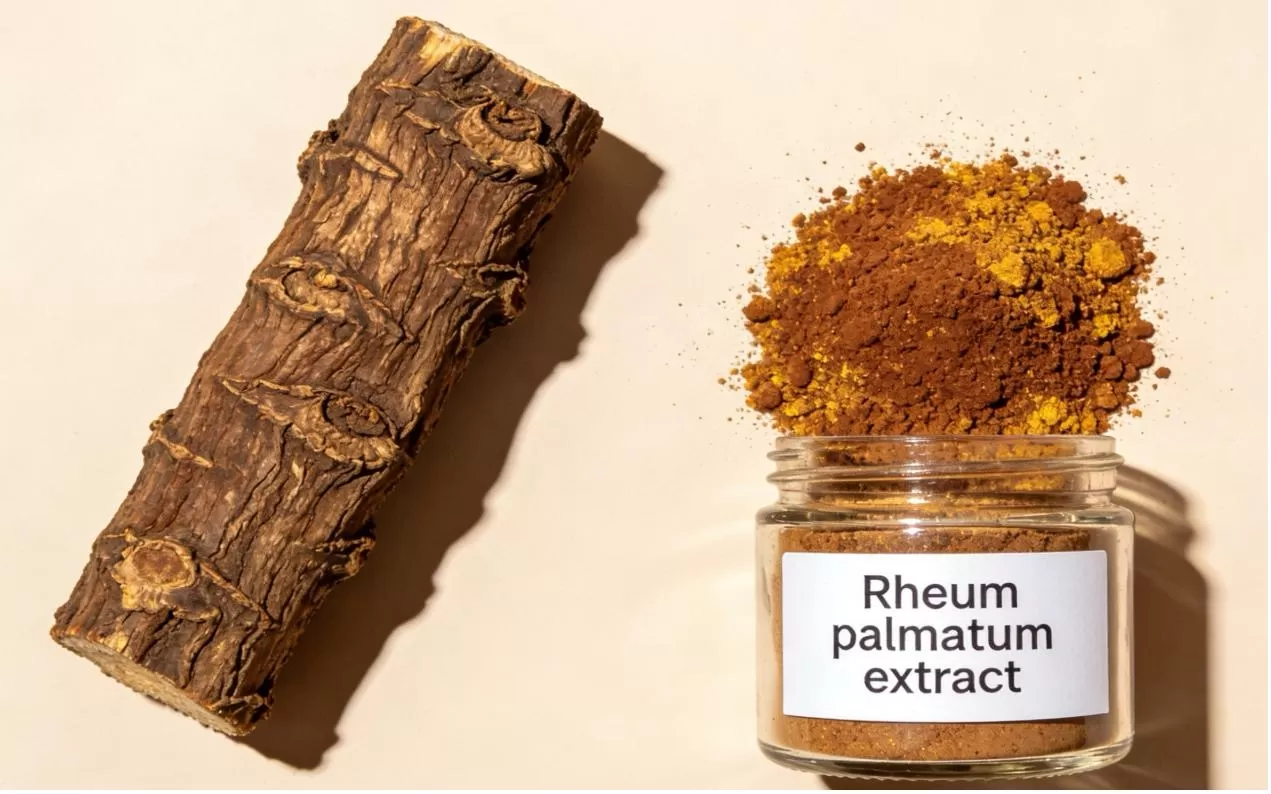
Part 1: What Exactly Is Rheum palmatum Extract?
Let’s start with the basics. Rheum palmatum (Latin name: Rheum palmatum L.) is a perennial herb native to the mountainous regions of Western China and parts of the Himalayas. It’s one of the most prized species in the Polygonaceae family, and its roots and rhizomes have been harvested for medicinal use for over two thousand years .
The Plant & Its Origins
What makes Rheum palmatum stand out? It thrives in high-altitude environments, which may contribute to its rich concentration of defensive compounds—exactly the molecules we’re after for health applications. Today, it’s cultivated not only in China but also in parts of Europe and Russia, though Chinese-grown material remains the gold standard for active content.
What Part Do We Use?
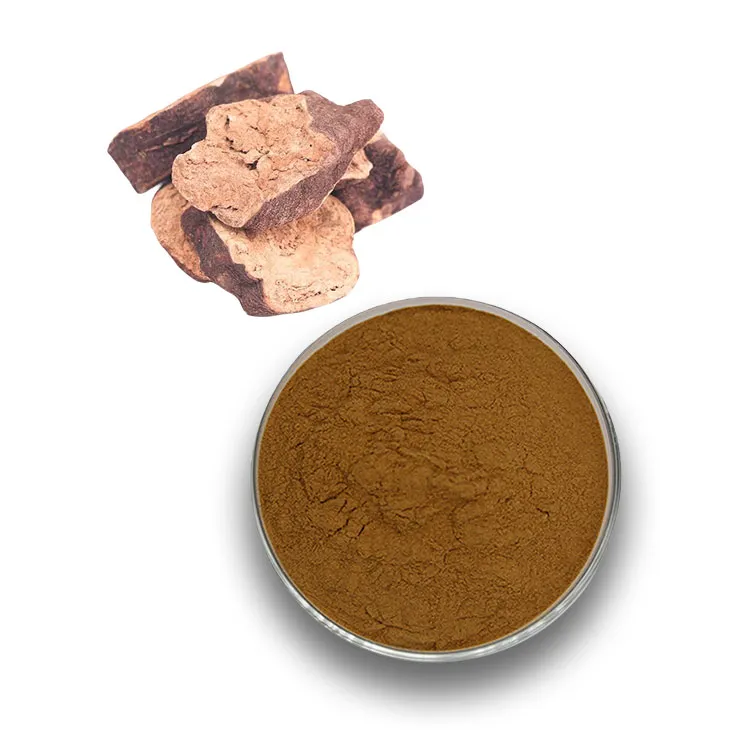
We specifically use the dried root and rhizome. These underground parts are where the plant stores its most potent phytochemicals. Interestingly, recent research has also explored using the stems as a nutritional food source, rich in amino acids and minerals, but for concentrated extracts, the root is where the magic happens .
The Active Components (This Is Where It Gets Technical)
The efficacy of Rheum palmatum extract comes down to its complex chemical profile. Over 140 compounds have been identified in Rheum species, but the star players are anthraquinones and their derivatives . When you’re looking at a specification sheet, here’s what you want to see:
l Rhein – Often considered the primary active ingredient in antioxidant and anti-inflammatory effects .
l Emodin – Known for its immunomodulatory and anti-proliferative activities .
l Chrysophanol – Contributes to antiviral and anti-inflammatory properties .
l Aloe-emodin and Physcion – Complete the anthraquinone family, each adding to the extract’s therapeutic breadth .
Our Standard Specifications
We offer Rheum palmatum root extract standardized to key anthraquinone content to ensure batch-to-batch consistency:
l Standard Grade: 20% anthraquinones (by HPLC)
l High Purity Grade: 50% anthraquinones (ideal for pharmaceutical applications)
l Custom blends: Available upon request
Quality You Can Trust
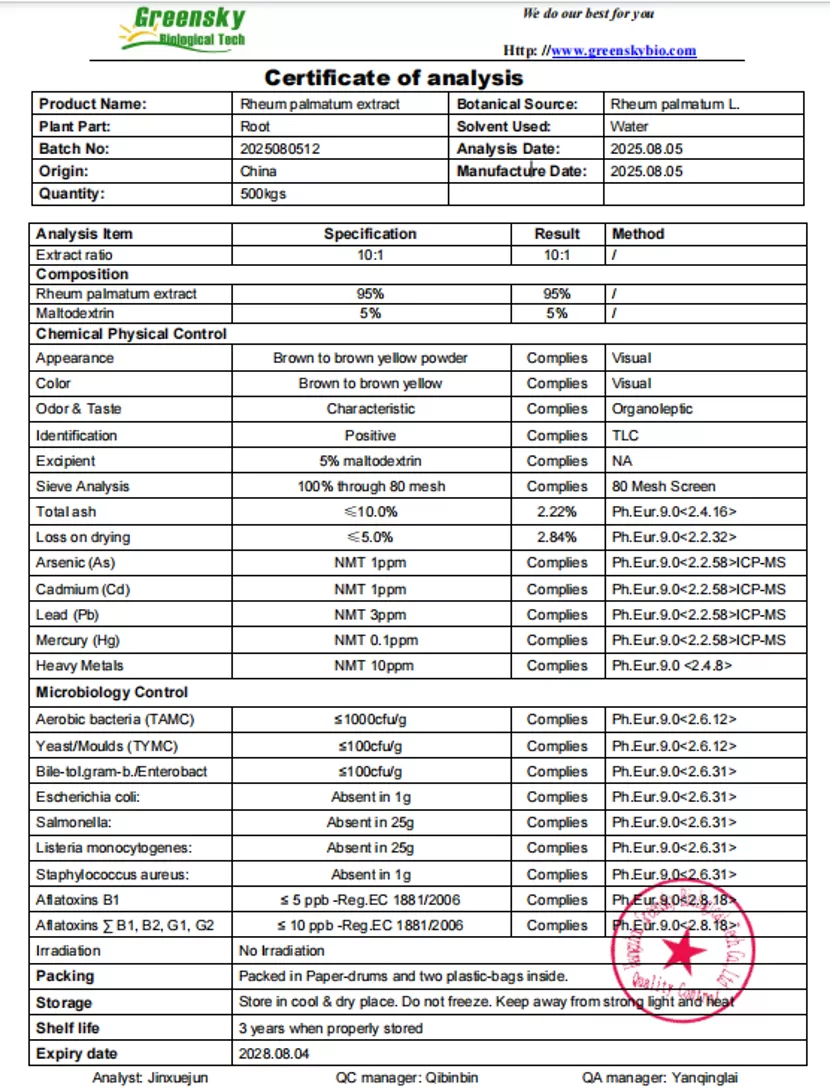
We don’t do guesswork. Every batch of our Rheum palmatum extract comes with a Certificate of Analysis (COA) detailing:
l Anthraquinone content (rhein, emodin, chrysophanol, etc.) by HPLC
l Heavy metal testing (Pb, As, Cd, Hg)
l Microbiological profiles (total plate count, yeast & mold, pathogens)
l Residual solvent analysis
l Pesticide screening
We also adhere to the ISO 5228:2023 standards for Rheum root and rhizome, ensuring compliance with international quality benchmarks for natural medicines .
Part 2: Core Benefits & How It Works (With Science to Back It Up)
Now for the part you probably care about most: What does this extract actually do? Let’s walk through the primary mechanisms, each supported by peer-reviewed research.
1. Powerful Antioxidant Activity
Oxidative stress—caused by an overload of free radicals—is a key driver of aging and chronic disease. Rheum palmatum extract is a formidable antioxidant. A 2024 study published in the Journal of Ethnopharmacology demonstrated that water extract of Rheum palmatum significantly reduced reactive oxygen species (ROS) in the kidney and spleen of mice under oxidative stress. The treatment also lowered liver concentrations of oxidative stress markers like superoxide dismutase (SOD) by 27% and glutathione peroxidase (GSH-Px) by 32%, indicating a systemic antioxidant effect .
Bottom line: It helps mop up the cellular "rust" before it causes damage.
2. Anti-Inflammatory Action
Inflammation is a necessary immune response, but when it becomes chronic, it’s a problem. Rheum palmatum extract steps in here, too. Research on the stems of the plant (which share many compounds with the root) showed anti-inflammatory activity via the PI3K-Akt-mediated NF-κB pathway . In plain English? It helps dial down the body’s inflammatory signaling cascade at a fundamental level.
Another study focusing on psoriasis—a condition driven by chronic inflammation—found that an ethanolic extract of Rheum palmatum reduced inflammatory cytokines and proliferation markers in the skin .
3. Skin Health & Psoriasis Support
Speaking of skin, this is one of the most exciting application areas. The same 2022 study in the International Journal of Molecular Sciences revealed that topical application of Rheum palmatum extract alleviated psoriasis-like symptoms in an animal model. The anthraquinones—particularly rhein and emodin—were found to inhibit key inflammatory pathways like IL-17, MAPK, and TNF signaling .
This positions Rheum palmatum extract as a promising natural alternative or adjunct for managing inflammatory skin conditions.
4. Antiviral Potential
While we always caution that extracts are not drugs, the antiviral research is compelling. A study in the Archives of Pharmacal Research tested Rheum palmatum methanol extract against Japanese encephalitis virus. The extract, along with its component chrysophanol, showed significant antiviral activity, reducing viral plaque formation . This opens the door for further research into immune-support applications.
5. Metabolic Support
The 2024 study also noted an intriguing side effect: Rheum palmatum supplementation decreased serum glucose concentrations in oxidative-stressed mice (2.3 mmol/L vs. 4.1 mmol/L in the control group) . While animal studies don’t always translate directly to humans, this suggests potential benefits for metabolic health that warrant further exploration.
Part 3: Where Is It Used? A Look at Key Applications
One of the things I love about Rheum palmatum extract is its versatility. It’s not a one-trick pony. Here’s where we’re seeing it make an impact across industries.
Dietary Supplements & Nutraceuticals
This is the largest application area. Capsules, tablets, and powders containing Rheum palmatum extract are formulated for:
l Digestive health (traditional use as a mild laxative)
l Antioxidant support formulas
l Immune health blends
l Metabolic health supplements
Functional Foods & Beverages
Given the GRAS (Generally Recognized as Safe) status of rhubarb derivatives in many regions, and the recent research into nutritional applications of the stems, we’re starting to see Rheum palmatum extracts appear in:
l Energy bars (for antioxidant boost)
l Herbal teas and infusions
l Functional shots targeting inflammation
Cosmetics & Personal Care
The anti-inflammatory and antioxidant properties make it a darling of natural skincare. You’ll find it in:
l Anti-aging serums (targeting oxidative stress)
l Soothing creams for sensitive or reactive skin
l Scalp treatments for inflammatory conditions
l Acne formulations (thanks to its antibacterial anthraquinones)
Animal Nutrition
Yes, even our four-legged friends can benefit. A 2024 study specifically highlighted the potential of Rheum palmatum as a medicinal supplement for animals, noting its ability to mitigate organ lesions caused by oxidative stress . It’s being explored as a natural additive for:
l Livestock feed to improve general health
l Companion animal supplements for joint and skin support
Part 4: How to Choose a High-Quality Rheum palmatum Extract
Not all extracts are created equal. If you’re sourcing for product development, here’s what you need to look for—and where we shine.
1. Standardization Is Everything
Cheap extracts often contain "empty" plant material with minimal active compounds. A quality supplier will provide a standardized extract with guaranteed levels of key anthraquinones (rhein, emodin, etc.). Our extracts are rigorously tested by HPLC to confirm potency.
2. Clean Extraction Methods
How the extract is made matters. We use food-grade ethanol and water extraction—no harsh residual solvents. For certain applications, we also offer CO2-extracted variants that preserve delicate compounds.
3. Third-Party Testing
Don’t just take our word for it. We provide full COAs from accredited labs, covering identity, purity, and safety. We also offer samples so you can test compatibility with your formulations.
4. Sustainability & Traceability
We source our Rheum palmatum roots from sustainable wild-harvested and cultivated sources in China’s Gansu and Sichuan provinces. We know the growers, we know the land, and we maintain full traceability from root to extract.
5. Certifications
Depending on your market, you may need:
l Organic certification (USDA/EU)
l Kosher and Halal certifications
l Non-GMO verification
We offer all of the above. Just ask.
Part 5: About Us—Your Trusted Partner in Botanical Actives
We’re not just another ingredient supplier. We’re a team of plant chemists, pharmacists, and supply chain professionals who genuinely care about bridging the gap between traditional herbal wisdom and modern science.
For over a decade, we’ve specialized in high-quality plant extracts for the nutraceutical, cosmetic, and functional food industries. Our Rheum palmatum extract reflects everything we stand for:
✅ Rigorous Quality Control – Every batch is tested for identity, potency, and safety.
✅ Scientific Backing – We don’t just sell ingredients; we provide the research to support their use.
✅ Customization – Need a specific particle size, solubility profile, or blend? We can do that.
✅ Stable Supply – Long-term contracts with growers ensure you never face a stockout.
✅ Technical Support – Our in-house formulation experts are here to help you succeed.
Part 6: Final Thoughts & Next Steps
Rheum palmatum extract is far more than a traditional herb. With a growing body of peer-reviewed research supporting its antioxidant, anti-inflammatory, and skin-health benefits, it’s a versatile ingredient ready for modern formulation .
Whether you’re developing a cutting-edge skincare line, a potent new supplement, or a functional food product, this botanical active deserves a spot on your shortlist.
Ready to see it for yourself?
We’d love to work with you. Here’s how to get started:
l Email us at [your email address] for a detailed product data sheet.
l Request a sample to test in your own formulations.
l Schedule a call with our technical team to discuss custom specifications.
Let’s create something remarkable together.
References
1. Ma, C. F., et al. (2024). The water extract of Rheum palmatum has antioxidative properties and inhibits ROS production in mice. Journal of Ethnopharmacology, 335, 118602.
2. Nguyen, L. T. H., Ahn, S. H., Shin, H. M., & Yang, I. J. (2022). Anti-Psoriatic Effect of Rheum palmatum L. and Its Underlying Molecular Mechanisms. International Journal of Molecular Sciences, 23(24), 16000.
3. Shang, X., et al. (2022). A high-value-added application of the stems of Rheum palmatum L. as a healthy food: the nutritional value, chemical composition, and anti-inflammatory and antioxidant activities. Food & Function, 13(9), 4901–4913.
4. Yang, X., et al. (2024). The phytochemistry and pharmacology of three Rheum species: A comprehensive review with future perspectives. Phytomedicine.
5. Study on the Quality Standard for Mongolian Medicine Yishen Powder. (2017). China Pharmacy, (12), 823–826.
6. SIRB-001 MeSH Supplementary Concept Data. (2018). National Library of Medicine.
7. ISO 5228:2023. Traditional Chinese medicine — Rheum palmatum, Rheum tanguticum and Rheum officinale root and rhizome. International Organization for Standardization.
8. Chang, S. J., et al. (2014). Antiviral activity of Rheum palmatum methanol extract and chrysophanol against Japanese encephalitis virus. Archives of Pharmacal Research, 37(9).
TEST REPORT
- ▶ Hesperidin
- ▶ Citrus Bioflavonoids
- ▶ Plant Extract
- ▶ lycopene
- ▶ Diosmin
- ▶ Grape seed extract
- ▶ Sea buckthorn Juice Powder
- ▶ Fruit Juice Powder
- ▶ Hops Extract
- ▶ Artichoke Extract
- ▶ Mushroom extract
- ▶ Astaxanthin
- ▶ Green Tea Extract
- ▶ Curcumin
- ▶ Horse Chestnut Extract
- ▶ Other Product
- ▶ Boswellia Serrata Extract
- ▶ Resveratrol
- ▶ Marigold Extract
- ▶ Grape Leaf Extract
- ▶ New Product
- ▶ Aminolevulinic acid
- ▶ Cranberry Extract
- ▶ Red Yeast Rice
- ▶ Red Wine Extract
- ▶ blog
-
Licorice Root Extract Powder
2026-03-12
-
Nutmeg Extract
2026-03-12
-
Centella Asiatica Extract
2026-03-12
-
Black Rice Extract
2026-03-12
-
Dan Shen Root Extract/Salvia Root Extract
2026-03-12
-
Red Wine Extract
2026-03-12
-
Acerola Extract
2026-03-12
-
Baobab Fruit Extract
2026-03-12
-
Sea buckthorn oil
2026-03-12
-
Green coffee bean Extract
2026-03-12
