- 0086-571-85302990
- [email protected]




Cranberry Extract
2023-05-12
Product Name: Cranberry Extract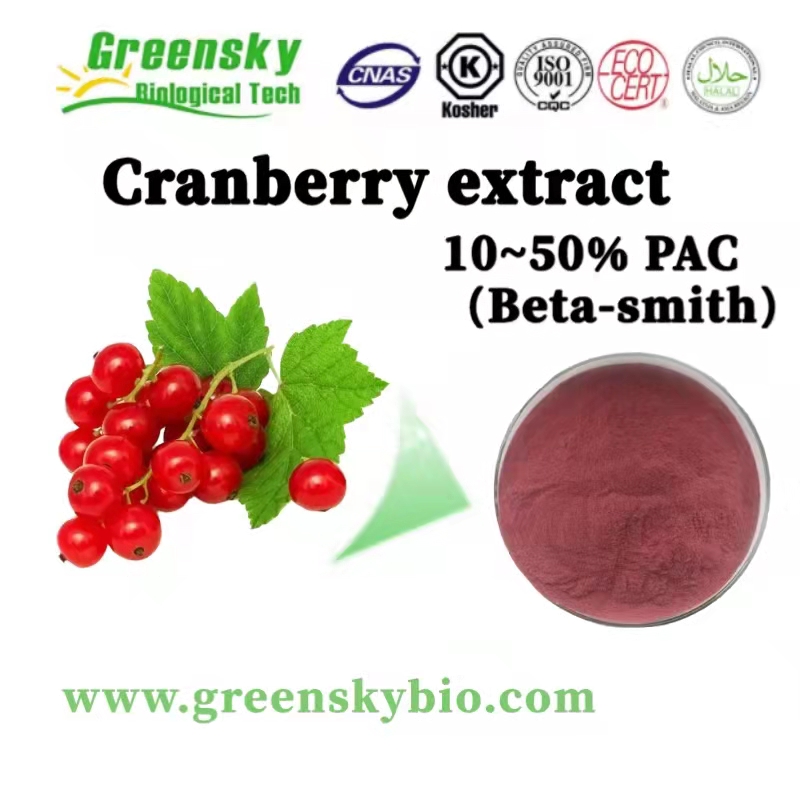
is a concentrated botanical ingredient derived from the fruit of Vaccinium macrocarpon (American cranberry) or Vaccinium vitis-idaea (lingonberry/European cranberry). Cranberries are among the most extensively researched fruits for urinary tract health, and their extract has become a staple ingredient in the global dietary supplement market.
The global Cranberry Extract market is valued at approximately USD 120-160 million (2024) and is growing at 7-9% CAGR, driven by increasing consumer awareness of urinary tract health, demand for natural alternatives to synthetic ingredients, and the expansion of the women's health supplement category.
Key Active Compounds: Proanthocyanidins (PACs)
The primary bioactive compounds responsible for cranberry's health benefits are A-type proanthocyanidins (PACs) — unique oligomeric flavonoids that distinguish cranberry from most other fruits, which typically contain B-type PACs.
Compound Classification Key Activity A-type PACs (dimers, trimers, tetramers) Condensed proanthocyanidins Anti-adhesion activity against uropathogenic E. coli Anthocyanins (cyanidin, peonidin glycosides) Water-soluble flavonoids Antioxidant, color contribution Quercetin and myricetin Flavonols Antioxidant, anti-inflammatory Benzoic acid derivatives Organic acids Antimicrobial, preservative activity Vitamin C (ascorbic acid) Water-soluble vitamin Immune support, antioxidant
A-Type vs. B-Type Proanthocyanidins: Why It Matters
Feature A-Type PACs (Cranberry) B-Type PACs (Most Other Fruits) Bond structure Double linkage (C4→C8 + C2→O→C7) Single linkage (C4→C8 or C4→C6) Anti-adhesion activity Strong — prevents bacterial fimbriae attachment Minimal to none Primary sources Cranberry, lingonberry, cinnamon Grape seed, cocoa, apple, pine bark Urinary tract benefit Clinically supported Not applicable
The A-type PAC structure is the scientific basis for cranberry's unique urinary tract health benefits. This is why standardization to PAC content — not just total anthocyanins or total polyphenols — is critical for product efficacy.
Cranberry Species Comparison
Species Common Name PAC Content Commercial Use Vaccinium macrocarpon American cranberry Highest A-type PACs Primary commercial source Vaccinium vitis-idaea Lingonberry High A-type PACs European market, specialty products Vaccinium oxycoccos Small cranberry Moderate PACs Regional use in Northern Europe Vaccinium angustifolium Wild blueberry B-type PACs Different applications
Extraction Methods
Solvent Extraction (Industry Standard)
The most widely used commercial method for Cranberry Extract production:
Process Flow:
Raw material preparation — Fresh or frozen cranberries are washed, sorted, and crushed
Solvent extraction — Water, ethanol, or ethanol-water mixture (30-70%) is used at 30-60°C for 1-3 cycles
Filtration — Solid residues (skins, seeds) are removed via filtration and centrifugation
Concentration — Solvent is recovered via vacuum evaporation; extract is concentrated
Spray drying — Maltodextrin or other carriers may be added for spray-dried powder production
Standardization — Extract is standardized to target PAC content
Yield: Typically 5-15% extract from fresh fruit, depending on extraction method and standardization target
Supercritical CO₂ Extraction (for Specific Fractions)
Used to isolate lipophilic cranberry compounds (seed oils, specific triterpenoids)
Not the primary method for PAC-rich extracts (PACs are water-soluble)
Can be used in combination with solvent extraction for full-spectrum products
Membrane Filtration Technology
Emerging technology for PAC enrichment:
Uses ultrafiltration (UF) and nanofiltration (NF) membranes to concentrate PAC fractions
Can achieve PAC enrichment without organic solvents
Reduces energy consumption and processing time
Application: Clean-label and organic-certified cranberry extracts
Standardization Grades and Specifications
Common Cranberry Extract Grades
Grade PAC Content (DMAC Method) Primary Use Standard cranberry powder 1-3% PACs General health supplements, food applications PAC-standardized extract 10-25% PACs Urinary tract health supplements High-potency PAC extract ≥30% PACs Clinical-grade formulations, professional products Whole fruit powder 0.5-1% PACs Food fortification, functional foods
Quality Specification Sheet (PAC 25%)
Parameter Specification Test Method Proanthocyanidins (PACs) ≥25% (DMAC method) DMAC assay Total anthocyanins ≥1.5% pH differential method Total polyphenols ≥40% Folin-Ciocalteu Moisture ≤5.0% USP <731> Heavy metals Pb ≤1.0 ppm, As ≤1.0 ppm, Cd ≤0.5 ppm, Hg ≤0.1 ppm ICP-MS Pesticide residues Compliant with EU limits GC-MS/LC-MS Microbial limits TPC <1,000 CFU/g, Yeast/Mold <100 CFU/g USP <61>, <62> Salmonella Negative/25g USP <62> E. coli Negative/g USP <62> Solvent residues Ethanol <5,000 ppm GC (USP <467>)
The DMAC Method: Why It's the Gold Standard for PAC Testing
The DMAC (4-dimethylaminocinnamaldehyde) assay is the most widely accepted analytical method for quantifying A-type PACs in cranberry extracts. Unlike older methods that measured total polyphenols (which include non-PAC compounds), the DMAC method specifically reacts with the terminal units of proanthocyanidin chains, providing a more accurate measure of the bioactive fraction.
Industry note: Be cautious of suppliers who quote "total polyphenol" content instead of PAC content. A cranberry extract with 40% total polyphenols may contain only 5-10% PACs. Always request DMAC assay results.
Clinical Evidence and Dosage
Urinary Tract Health
The most extensively researched application of cranberry extract:
Mechanism: A-type PACs prevent uropathogenic E. coli (UPEC) from adhering to the urinary tract epithelium, reducing the ability of bacteria to colonize and cause infection
Effective dose: 36 mg PACs per day (based on the widely cited "36 mg PAC" threshold from clinical literature)
Study populations: Most research focuses on women with recurrent urinary tract discomfort
Safety: Generally recognized as safe (GRAS); suitable for long-term use
Antioxidant and Cardiovascular Support
Emerging research suggests additional benefits:
Cranberry polyphenols may support endothelial function and vascular health
Antioxidant activity may contribute to overall cardiovascular wellness
Anti-inflammatory properties may support gum and oral health
Common Formulations
Product Type Typical PAC Dose per Serving Form Capsules/Tablets 18-36 mg PACs Standard capsules Gummies 10-25 mg PACs Children's and adult gummies Effervescent tablets 36 mg PACs Dissolvable tablets Liquid concentrates 18-36 mg PACs Drops, syrups Combination formulas Variable Often paired with D-mannose, vitamin C
Applications in the Supplement Industry
Women's Health Supplements
The largest and fastest-growing application segment, accounting for approximately 50% of cranberry extract demand in the B2B supplement market.
General Wellness Products
Used in daily multivitamin/mineral formulas for its antioxidant and immune-support properties.
Functional Beverages
Growing segment for cranberry-fortified juices, wellness shots, and hydration products.
Pet Health Supplements
An emerging application — cranberry extract is increasingly used in urinary health formulas for dogs and cats.
Why Choose Greensky Bio as Your Cranberry Extract Supplier
Hangzhou Greensky Biological Tech Co., Ltd. brings over 20 years of expertise in natural plant extract manufacturing to cranberry extract production. Our Jiangxi facility operates under ISO22000, BRCGS, Ecocert Organic Standard, and SGS-GMP certifications, ensuring the highest quality standards for every batch.
Our Advantages
PAC-standardized products: Extracts standardized to 10%, 25%, or 30%+ PACs via DMAC assay
Flexible formats: Spray-dried powders, liquid concentrates, and water-soluble options available
Organic certification: Ecocert-certified organic cranberry extract available
Custom blending: We can formulate cranberry extract with D-mannose, vitamin C, or other synergistic ingredients
Full documentation: COA, DMAC assay reports, heavy metal analysis, and regulatory support provided
Production capacity: Our multi-ton extraction tanks support orders from 100 kg to 50+ metric tons annually
-

Liposomal NMN Complete Guide
2023-05-12
-
Resveratrol Extract Complete Guide
2023-05-12
-
Resveratrol Extract Complete Guide
2023-05-12
-
-
-
-
-
-
citrus bioflavonoids benefits
2023-05-12
-
citrus bioflavonoids extract
2023-05-12