- 0086-571-85302990
- [email protected]





Diosmin
2023-05-08
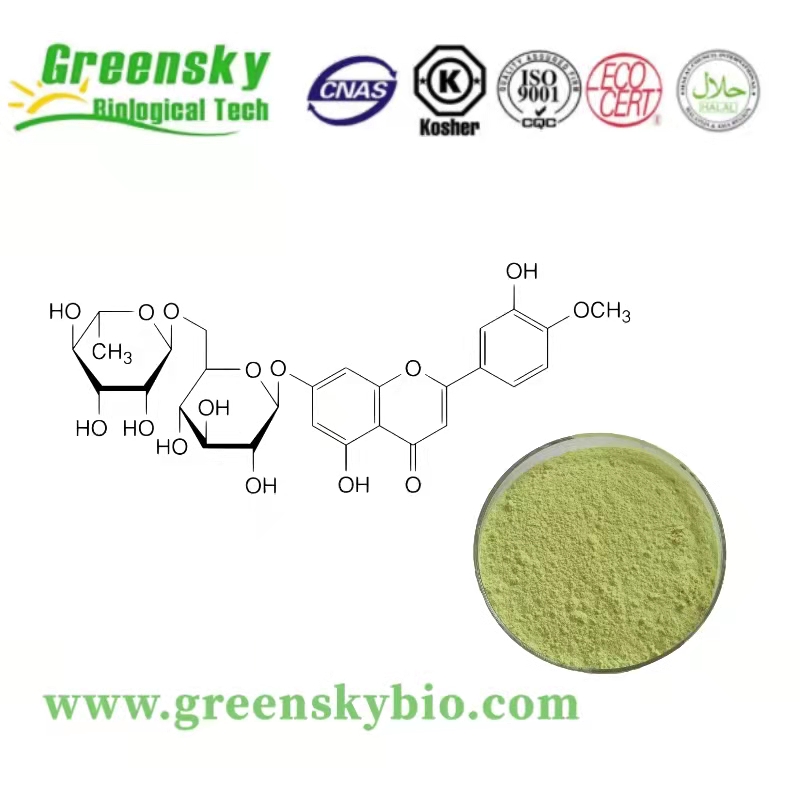
Diosmin is a naturally occurring flavonoid derived primarily from citrus fruits, particularly the peel of sweet orange (Citrus sinensis) and bitter orange (Citrus aurantium). As one of the most clinically validated flavonoids for venous and lymphatic health, Diosmin has become an essential active ingredient in pharmaceutical and dietary supplement formulations worldwide.
For B2B buyers sourcing Diosmin extract, understanding its pharmacological mechanisms, quality specifications, and reliable supply chains is critical for product development and regulatory compliance.
What Is Diosmin and How Does It Work?
Diosmin (chemical formula C₂₈H₃₂O₁₅) is a glycosylated flavonoid belonging to the flavone subclass. In nature, it is found predominantly in citrus fruit peels alongside Hesperidin — another bioactive flavonoid with synergistic venotonic properties.
Mechanism of Action
Diosmin exerts its therapeutic effects through several well-documented pathways:
Venotonic Activity: Diosmin enhances venous tone by increasing the responsiveness of venous smooth muscle to norepinephrine, reducing venous capacitance and distensibility. This improves venous return and reduces pooling.
Lymphatic Enhancement: Diosmin increases lymphatic vessel contraction frequency and intensity, promoting lymph drainage and reducing interstitial fluid accumulation (edema).
Microcirculation Protection: Diosmin reduces capillary permeability and fragility, protecting microvascular integrity. It also inhibits the release of inflammatory mediators including prostaglandins and thromboxane A2.
Anti-inflammatory Effects: Diosmin suppresses leukocyte activation, adhesion, and migration — key processes in the pathogenesis of chronic venous disease and hemorrhoidal inflammation.
Antioxidant Properties: As a flavonoid, diosmin scavenges free radicals and reduces oxidative stress in vascular endothelial cells.
Clinical Evidence and Health Applications
Chronic Venous Insufficiency (CVI)
Diosmin is the cornerstone active ingredient in the treatment of chronic venous insufficiency, a condition affecting up to 40% of adults in developed countries. Multiple randomized controlled trials have demonstrated that diosmin supplementation significantly reduces:
Leg heaviness and fatigue
Ankle and calf edema
Night cramps and restlessness
Visible varicose vein symptoms
A comprehensive meta-analysis published in Phlebology (2023) confirmed that diosmin-based treatments significantly improve clinical signs and symptoms of CVI compared to placebo, with a favorable safety profile.
Hemorrhoid Treatment
Diosmin, typically combined with Hesperidin in a standardized ratio, is extensively used in both prescription and over-the-counter hemorrhoid treatments. Clinical evidence supports its efficacy in:
Reducing acute hemorrhoidal attack severity and duration
Decreasing bleeding, pain, and discharge
Preventing recurrence of hemorrhoidal episodes
The standard therapeutic protocol for acute hemorrhoidal episodes involves a higher initial dose (typically 3000 mg/day for 4 days, then 2000 mg/day for 3 days), followed by a maintenance dose of 1000 mg/day.
Lymphedema Management
Diosmin's lymphotonic properties make it valuable as an adjunct therapy for lymphedema management, particularly in post-surgical and post-radiation contexts. Studies have shown significant reductions in limb circumference and subjective discomfort scores with diosmin supplementation.
Natural Sources of Diosmin
Primary Botanical Sources
Source Diosmin Content Notes Sweet orange peel (Citrus sinensis) High Most common commercial source Bitter orange peel (Citrus aurantium) Moderate-High Secondary commercial source Lemon peel (Citrus limon) Moderate Less commonly used commercially Grapefruit peel (Citrus paradisi) Low-Moderate Minor source
Why Citrus Peel?
Citrus fruit peels represent the most abundant and sustainable source of diosmin. The flavonoid concentration in citrus peels is significantly higher than in the fruit pulp, making peel extraction both economically and environmentally advantageous. This approach also supports circular economy principles by valorizing what would otherwise be agricultural waste.
Quality Specifications for B2B Buyers
When sourcing diosmin extract, B2B buyers should evaluate suppliers against the following key quality parameters:
Standard Product Specifications
Parameter Specification Diosmin Content ≥ 90%, ≥ 95%, ≥ 98% (HPLC) Appearance Yellow to pale yellow crystalline powder Particle Size 80-100 mesh (customizable) Moisture ≤ 2.0% Heavy Metals ≤ 10 ppm Arsenic ≤ 1 ppm Lead ≤ 2 ppm Cadmium ≤ 0.5 ppm Microbial Limits Complies with USP/EP standards Pesticide Residue Complies with EU/US Pharmacopeia
Certification Requirements
For international markets, diosmin suppliers should hold:
ISO 22000 — Food Safety Management
BRCGS — Global standard for food safety
GMP — Good Manufacturing Practice certification
HALAL & Kosher — For religious dietary compliance
Ecocert Organic — For organic-certified products
Diosmin vs. Synthetic Diosmin: Natural vs. Semi-Synthetic
Natural Citrus-Derived Diosmin
Extracted from citrus fruit peels using green extraction technologies
Preferred by supplement manufacturers and natural health brands
Supports clean-label product positioning
Higher market value in premium segments
Semi-Synthetic Diosmin (Micronized Purified Flavonoid Fraction — MPFF)
Produced through chemical modification of natural Hesperidin
Used in pharmaceutical-grade formulations
Micronization improves bioavailability
Standardized to specific particle size distributions
For most dietary supplement applications, natural citrus-derived diosmin is preferred due to clean-label trends and consumer preference for plant-based ingredients.
Market Trends and Demand (2026)
Growing Demand Drivers
Aging Population: Venous disorders prevalence increases with age, driving sustained demand in developed markets.
Phlebology Awareness: Growing clinical awareness of chronic venous disease as a legitimate medical condition.
Natural Health Trend: Consumer shift toward plant-based, natural active ingredients in both supplements and cosmetics.
Cosmetic Applications: Increasing use of diosmin in anti-cellulite and leg-care cosmetic formulations.
Emerging Markets: Rising demand in Asia-Pacific, Middle East, and Latin American markets.
Key Application Segments
Dietary Supplements: Tablets, capsules, softgels
Pharmaceutical Products: Prescription venotonic medications
Topical Formulations: Creams, gels for hemorrhoidal and venous use
Cosmetics: Anti-cellulite and leg-care products
Functional Beverages: Emerging category in Asian markets
Sourcing Diosmin Extract from Greensky Bio
Hangzhou Greensky Biological Tech. Co., Ltd. is a professional natural plant extract manufacturer with over 20 years of experience in the identification, research, development, and production of active herbal ingredients.
Why Choose Greensky Bio for Diosmin?
ISO 22000, BRCGS, Ecocert Organic, SGS-GMP Certified manufacturing facility
GMP-standard production with 100,000-class clean area
Independent laboratory equipped with HPLC, GC, UV for rigorous quality testing
Sustainable sourcing from citrus processing by-products
Custom specifications available including particle size and purity levels
Global export experience with main markets in Europe, USA, South Korea, and Russia
Annual production capacity of 500+ tons of plant extracts
Competitive pricing with reliable supply chain
Available Product Forms
Diosmin Extract Powder (90%, 95%, 98% HPLC)
Diosmin + Hesperidin Complex (various ratios)
Micronized Diosmin (custom particle size)
Custom formulations available upon request
Frequently Asked Questions
Q: What is the recommended daily dose of diosmin for venous health?A: The typical maintenance dose for chronic venous insufficiency is 1000 mg/day. For acute hemorrhoidal episodes, a higher initial dose of 3000 mg/day for 4 days is commonly used.
Q: Is diosmin safe for long-term use?A: Yes, clinical studies have demonstrated that diosmin is well-tolerated for long-term use with a favorable safety profile. Mild gastrointestinal discomfort is the most commonly reported side effect.
Q: What is the difference between diosmin and hesperidin?A: Both are citrus flavonoids with venotonic properties. Diosmin has stronger venotonic and lymphotonic effects, while hesperidin contributes additional antioxidant and anti-inflammatory benefits. They are often combined for synergistic effects.
Q: Can diosmin be used in cosmetic products?A: Yes, diosmin is increasingly used in anti-cellulite creams, leg-care gels, and other topical cosmetic formulations targeting microcirculation improvement.
Q: What certifications should I look for in a diosmin supplier?A: For food and supplement applications, look for ISO 22000, BRCGS, GMP, HALAL, and Kosher certifications. For organic products, Ecocert Organic certification is essential.
Conclusion
Diosmin remains one of the most scientifically validated botanical ingredients for venous and lymphatic health. With growing clinical evidence, expanding application segments, and increasing consumer awareness of natural vascular health solutions, the global diosmin market continues to show strong growth potential.
For B2B buyers, partnering with a certified, experienced manufacturer like Greensky Bio ensures access to high-quality, consistently sourced diosmin extract with full regulatory documentation and competitive pricing.
-

Liposomal NMN Complete Guide
2023-05-08
-
Resveratrol Extract Complete Guide
2023-05-08
-
Resveratrol Extract Complete Guide
2023-05-08
-
-
-
-
-
-
citrus bioflavonoids benefits
2023-05-08
-
citrus bioflavonoids extract
2023-05-08